Sometimes an idea arrives after a conversation has ended.
I was speaking with a friend who is passing through a difficult period. We discussed circumstances, responsibility, choices and the weight that certain experiences can leave behind.
Afterwards, an image came to my mind.
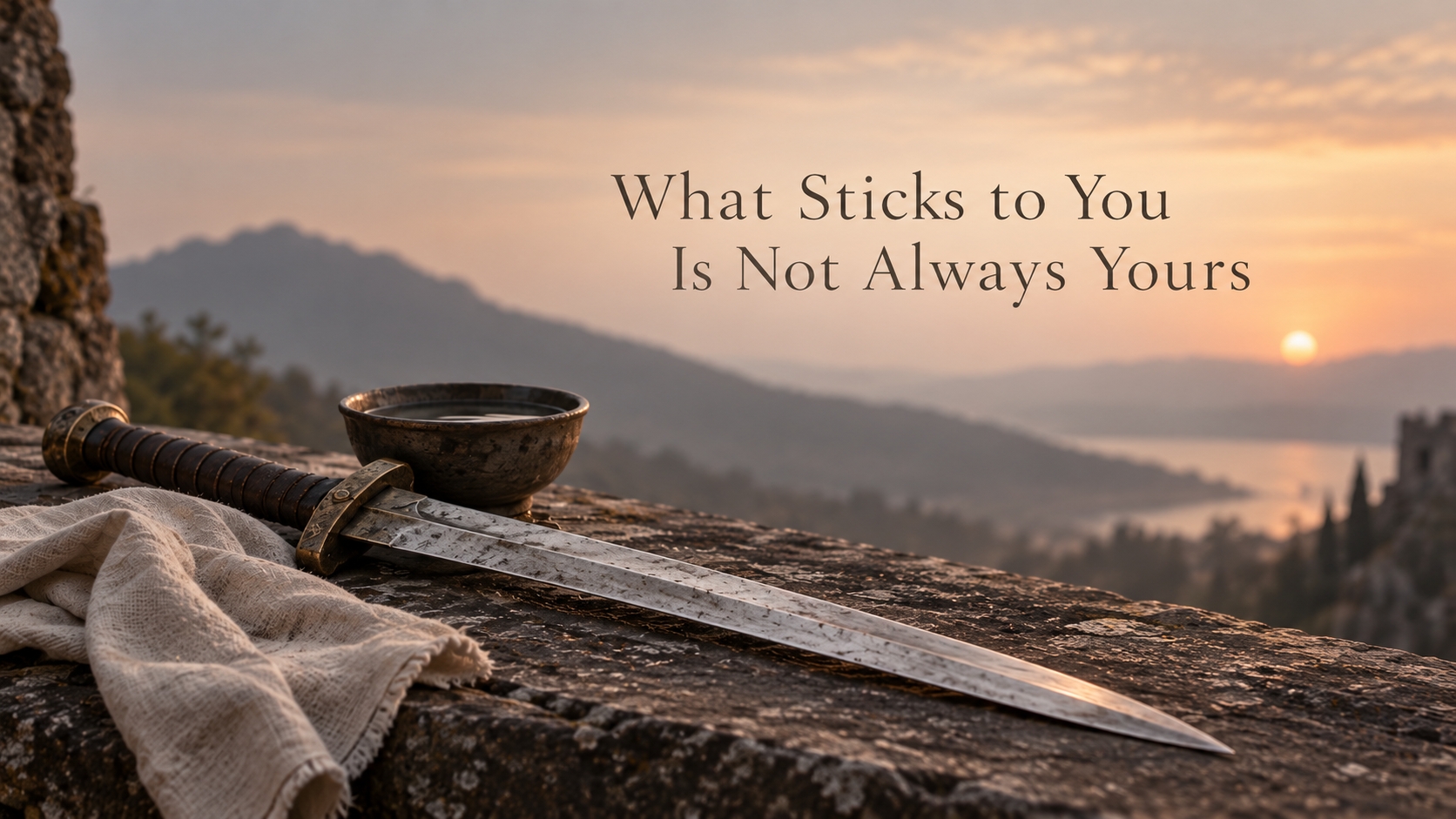
When a sword is used in battle, there may be blood on its blade.
The sword has performed its function. But before it can be used again, the blade needs to be cleaned.
The blood on the sword does not become the sword, nor does it become a part of it.
In much the same way, when someone cleans a neglected place, handles garbage or enters an unpleasant environment, some of that environment may temporarily remain on the person — the smell, the dust, the dirt.
That does not mean it belongs to them.
It simply means they came into contact with it.
The mistake we often make
Human beings sometimes do something very different.
When a difficult experience leaves something behind — guilt, disappointment, embarrassment, anger, financial loss, rejection or the consequences of a wrong decision — we begin to identify ourselves with what has attached itself to us.
Instead of saying:
“This happened to me.”
we gradually begin believing:
“This is me.”
That is a very important difference.
You may have made a mistake.
You may have trusted somebody you should not have trusted.
You may have taken a decision that produced an unexpected consequence.
You may even have knowingly entered a difficult situation because something had to be done.
Every action has consequences.
Some of them will leave marks.
But the mark is not necessarily your identity.
The more useful question is not whether something unpleasant has attached itself to you.
Sometimes that is unavoidable.
The question is:
What are you going to do with it now?
Clean the blade.
Wash the clothes.
Correct what can be corrected.
Learn what needs to be learnt.
Accept whatever genuinely belongs to you.
And release what does not.
Then become available again for the next piece of life.
We are also instruments of creation
That thought led me somewhere else.
Look around us.
Schools, universities, factories, trains, ships, roads, medicines, communication systems, books, music and technology — all of them began somewhere inside a human mind.
Someone saw something that did not yet exist.
Someone connected a few dots differently.
Someone acted.
Many creators never lived long enough to see the full impact of what they initiated.
Yet they became conduits through which something entered the world.
Some creations transformed humanity positively. Others produced unintended consequences. A few may even have caused enormous harm.
But the underlying phenomenon remains fascinating:
Human beings are instruments through which ideas become reality.
We receive.
We interpret.
We imagine.
We act.
And through those actions, the world changes.
Perhaps that is where our Old Currency lies
This is also one of the ways in which I have begun to understand what I call Old Currency.
Old Currency is not something sitting somewhere outside us waiting to be discovered.
It is the accumulated inner design we already carry — experience, instinct, perception, intelligence, memory, learning and perhaps something deeper that we do not always know how to describe.
The difficulty is that we are trying to spend this Old Currency in a very new world.
The circumstances have changed.
The language has changed.
Technology has changed.
Relationships have changed.
Work has changed.
Even our understanding of success, failure, responsibility and identity keeps changing.
The currency may still have value.
But we need to learn how to use it differently.
That requires us to pause occasionally and connect the dots.
To distinguish between what happened to us and what actually belongs to us.
To separate experience from identity.
To recognise the residue of yesterday without allowing it to dictate tomorrow.
And then to listen carefully enough to that inner design to understand what it may be asking us to create next.
Clean up. Reconnect. Move again.
Life will not always allow us to remain untouched.
If you work, love, build, lead, trust, experiment or attempt something meaningful, you will occasionally get your hands dirty.
That is part of participating in life.
The objective cannot be to remain permanently untouched.
The objective is to know how to return.
Clean what needs cleaning.
Repair what needs repairing.
Learn what needs learning.
Then reconnect with that part of you which is still capable of imagining, contributing and creating.
What has attached itself to you does not automatically belong to you.
And what happened yesterday does not necessarily define what you are capable of creating tomorrow.
Sometimes we simply need to clean the blade — and become available for the next mission.
— K. Srinivas Patnaik
This reflection connects with ideas explored in my book Old Currency in a New World: Understanding Karma in Modern Life.