Category: Reflections

  • What Next? One Action at a Time

    What Next? One Action at a Time

    As one task draws to a close, I ask myself a simple question: “What Next?”

    Sometimes the answer is immediately clear. Sometimes the question brings something to my attention that I had overlooked. Occasionally, it leads towards something I had never imagined doing.

    Through my ongoing experience, this question has become a way of bringing attention back to the present moment, recognising what needs doing and carrying out the next action.

    Old Currency in a New World: Understanding Karma in Modern Life draws from my personal experiences, some of which continue to unfold. The book is not a sugarcoated, “once upon a time” fairy-tale version of my past journey. Those who know me very closely know this. These reflections belong to that continuing exploration.

    Seven observations have gradually emerged from asking this question in everyday life.

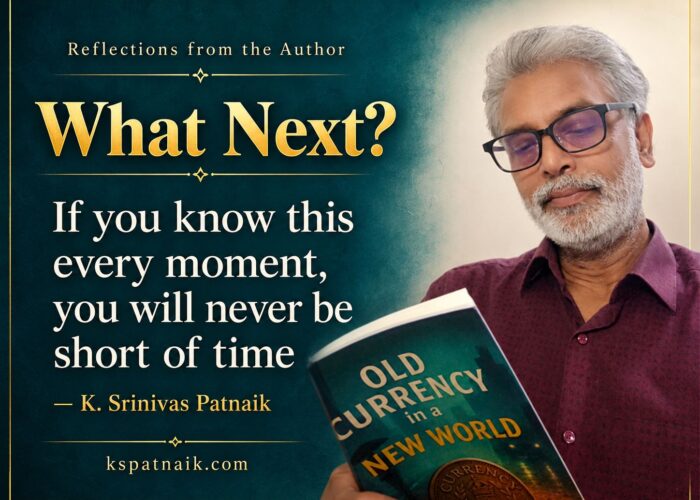
    “If you know this every moment, you will never be short of time.”

    That was the starting insight. For me, it points towards the time that can otherwise disappear into hesitation, divided attention and repeatedly wondering where to begin. When the next action becomes clear, we can give it our attention and proceed.

    The next reflection brought this observation into a simple practice:

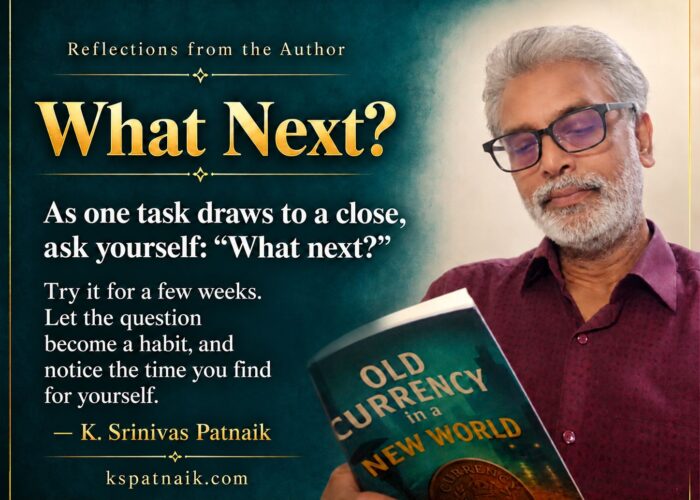
    “As one task draws to a close, ask yourself: ‘What next?’

    Try it for a few weeks. Let the question become a habit, and notice the time you find for yourself.”

    There is something useful about asking as a task approaches completion. We can finish what is in front of us and recognise what requires attention next. Repeated over several weeks, the question becomes familiar. The invitation is to try it and observe what happens in your own day.

    Of course, there are occasions when we already have a long list of things to do. That led to the third reflection:

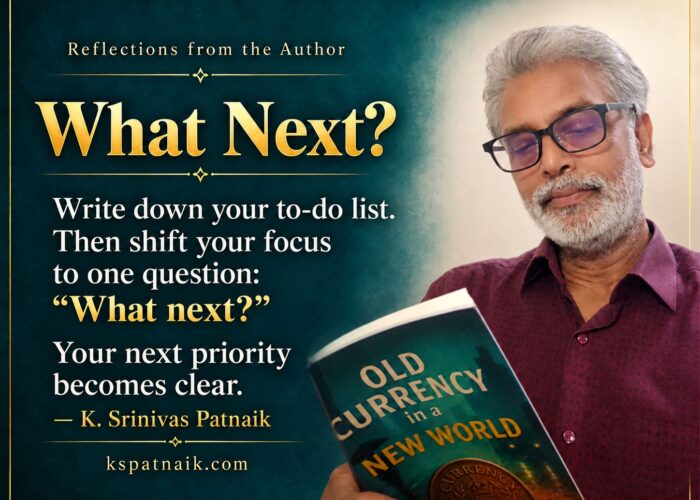
    “Write down your to-do list. Then shift your focus to one question: ‘What next?’ Your next priority becomes clear.”

    Writing things down gives the outstanding tasks a place outside the constant movement of our thoughts. The list holds what needs doing. The question helps us choose where to place our attention now.

    We can keep the result that matters in view while attending to the action that serves it at that moment.

    The same question also has a place when we feel there is nothing to do:

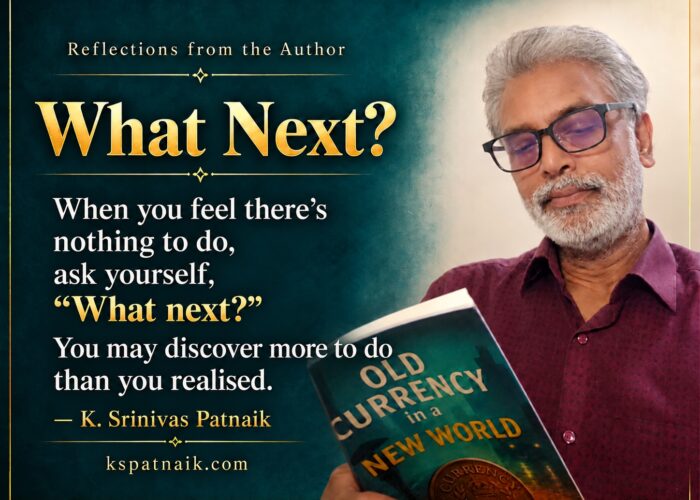
    “When you feel there’s nothing to do, ask yourself, ‘What next?’ You may discover more to do than you realised.”

    Sometimes there is something available that we have simply stopped noticing: an unfinished task, an interest waiting to be explored, a conversation to have or something we could learn. Asking the question can bring such possibilities into view.

    Then there are the more difficult moments:

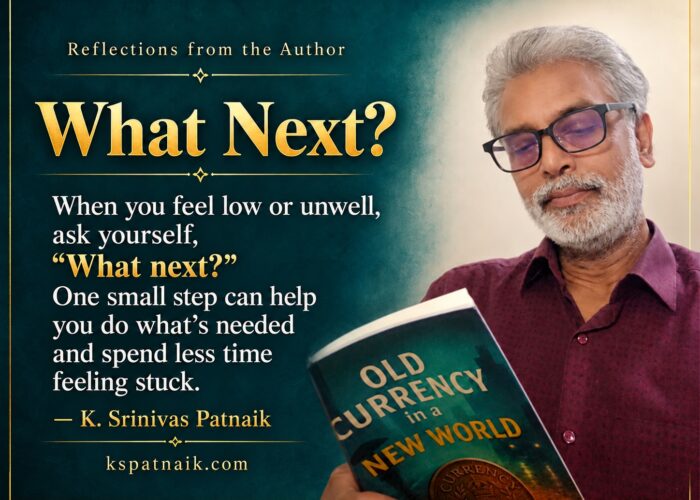
    “When you feel low or unwell, ask yourself, ‘What next?’ One small step can help you do what’s needed and spend less time feeling stuck.”

    In those moments, the next action needs to be manageable and appropriate. It could be a small task, a needed rest or reaching out to someone. We can respond to what the moment requires without mentally carrying everything that remains unfinished.

    As the practice develops, something less predictable may also appear:

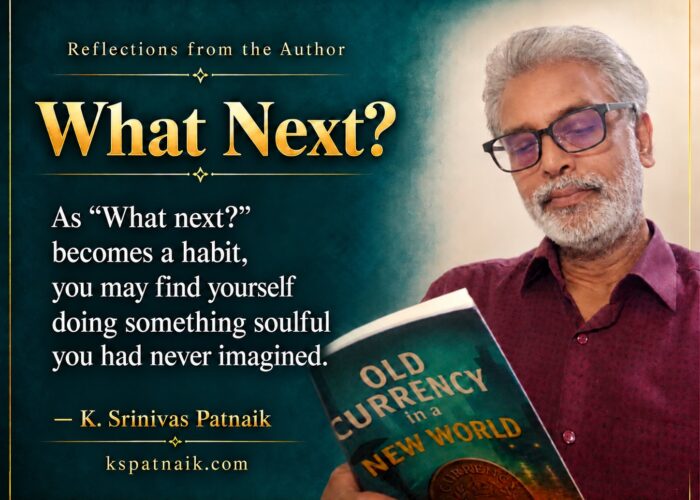
    “As ‘What next?’ becomes a habit, you may find yourself doing something soulful you had never imagined.”

    Even with a clear to-do list, something outside it may call for our attention. An unexpected interest or a quiet urge can become a meaningful experience when we act on it.

    In an earlier reflection, I wondered whether such a small deviation might carry karma’s imprint. “Your inner design beckons.” Those words express the meaning I see in such moments: something personally significant invites our attention before we have fully understood it.

    We can recognise that prompt, give it conscious attention, act on it appropriately and then continue with what needs doing. The experience itself may reveal why it mattered.

    The seventh reflection returns to what regular practice can develop:

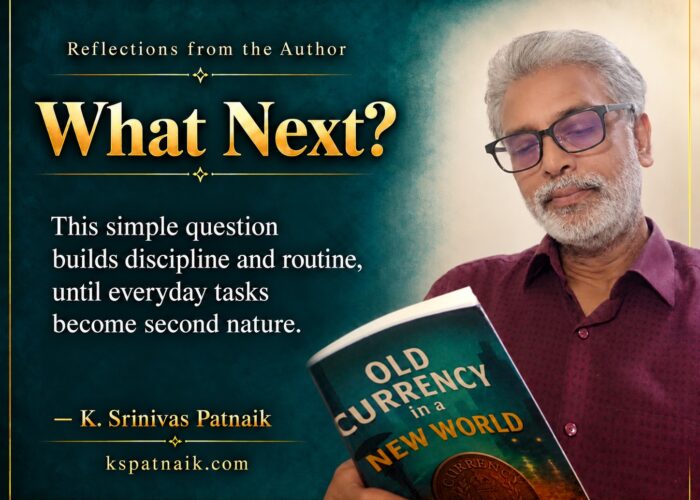
    “This simple question builds discipline and routine, until everyday tasks become second nature.”

    Initially, we practise remembering to ask the question. Gradually, asking and following through can become part of our everyday rhythm. Familiar activities acquire an ease that comes through repetition.

    “Second nature” describes that growing familiarity. The practice becomes part of how we move through the day.

    These seven reflections have also led me to look more closely at how experience, thought and action relate.
    Our respective and respected minds are shaped by different experiences. Even where our assumptions appear similar, the experiences behind them may be quite different.

    I often think of our daily experiences as experiments. We do something, encounter a result and learn from what happens. Some experiments succeed; some fail. Each gives us something further to work with.

    When I speak here of action, I mean consciously chosen bodily activities: typing a message, fetching water, boarding transport or attending a meeting. Reflexes and automatic bodily functions fall outside what I am discussing.

    A thought or decision can lead towards an action. The body carries out the chosen activity. Thinking about sending a message and actually typing and sending it are different stages.

    The context from which we choose an action comes from the mind: what we understand, expect, remember and consider possible. Our experience influences that context, and further action gives us new experience.

    I find it useful to picture experience as information, or data, and the mind as the processor working with it. This is the language through which I explore how what we have lived can influence what we imagine and what we choose to do.

    When I describe thoughts “travelling,” I mean something familiar. I can be sitting in Singapore and mentally walking through my garden in India, drawing on the visual memories of my last visit. My body is here while, in thought, I move through a remembered place.

    Education, knowledge, conversations and further experiences continually add to the material available to us. They widen the playing field for our thoughts.

    A possibility may emerge from that material. We choose to explore it, the body carries out an activity, and the resulting experience gives us something new to understand. The cycle continues.

    Yet sometimes we interrupt that movement by attaching a condition to an otherwise available action.

    “In Order To” creates an invisible link between two independent actions, resulting in a tug of war. You want to do something, “BUT” you need to do something else before that. Doesn’t that sound familiar? Yes, it does. On every such occasion, I have asked the person: “What have these two things got to do with each other? Aren’t they completely independent?”

    The link I am questioning is the one we impose where no practical dependency exists.

    Where one action genuinely requires another, give that requirement its place in the sequence. Completing the prerequisite may itself be the answer to “What Next?”

    For example, if I am waiting for a reply about one matter, I can still complete an independent task. If the reply is essential to a particular activity, I can identify what information is missing, ask for it and attend to another available action while waiting.

    The pending matter has its place. It need not occupy every moment in between.

    “What Next?” actually defuses that “BUT” by maintaining a constant focus on what needs to be done at that moment. Those actions are not linked; they are simply actions that need to be done at that moment. Executed, done and dusted… move on!

    The question brings attention back to what is available now. We can choose an action, carry it out, observe the result and learn from the experience.

    Over time, this can develop into a rhythm: clearer priorities, familiar routines and greater openness to something meaningful we had not anticipated.

    Try it for a few weeks. Write down what needs doing. As one task draws to a close, ask the question. When you feel stuck, look for a manageable step. When an unexpected possibility appears, give it conscious consideration.

    Notice what gets completed, what you learn and what becomes clearer through doing.

    As this reflection draws to a close, ask yourself:

    “What Next?”
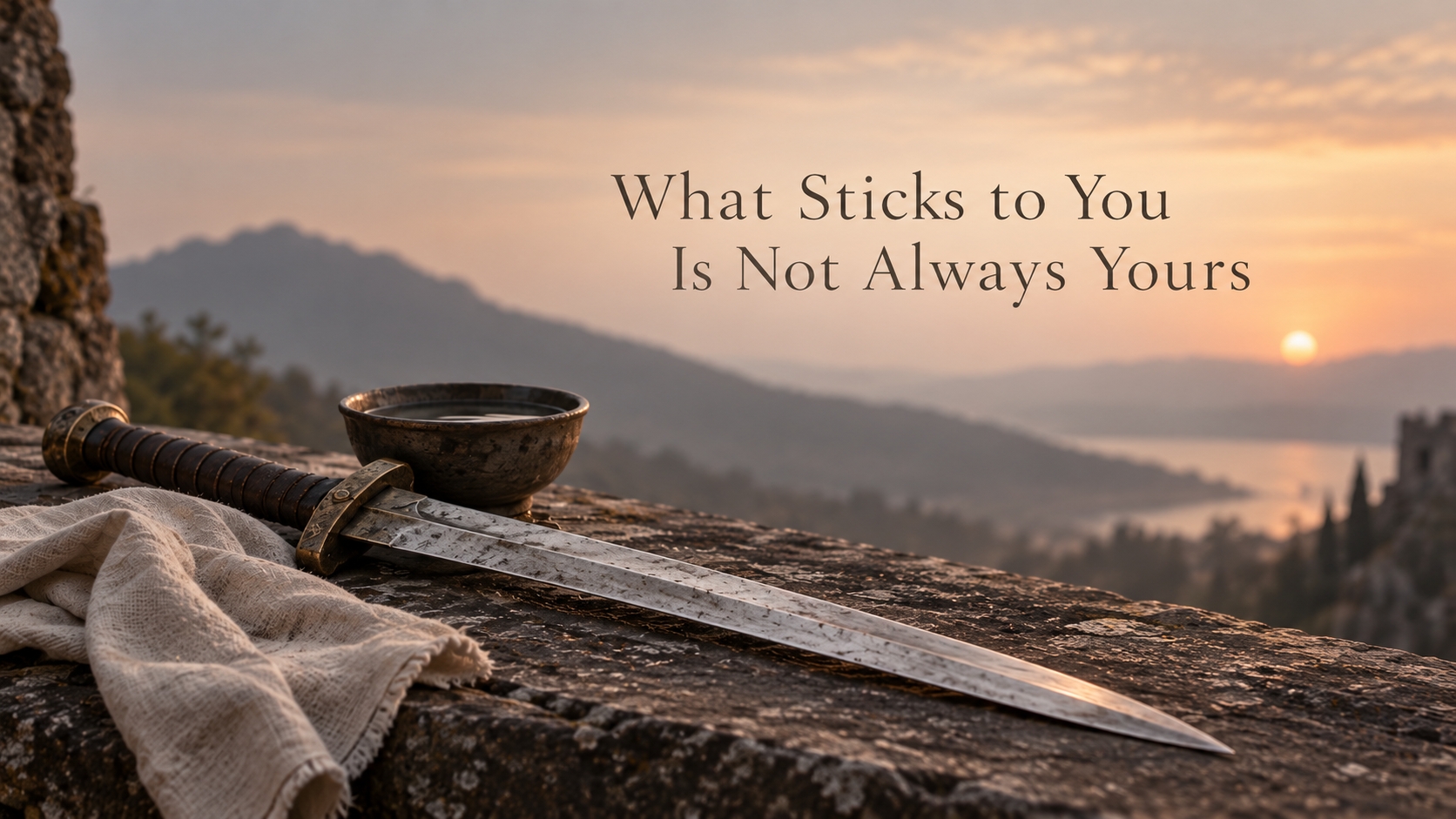
  • What Sticks to You Is Not Always Yours

    What Sticks to You Is Not Always Yours

    Sometimes an idea arrives after a conversation has ended.

    I was speaking with a friend who is passing through a difficult period. We discussed circumstances, responsibility, choices and the weight that certain experiences can leave behind.

    Afterwards, an image came to my mind.

    When a sword is used in battle, there may be blood on its blade.

    The sword has performed its function. But before it can be used again, the blade needs to be cleaned.

    The blood on the sword does not become the sword, nor does it become a part of it.

    In much the same way, when someone cleans a neglected place, handles garbage or enters an unpleasant environment, some of that environment may temporarily remain on the person — the smell, the dust, the dirt.

    That does not mean it belongs to them.

    It simply means they came into contact with it.

    The mistake we often make

    Human beings sometimes do something very different.

    When a difficult experience leaves something behind — guilt, disappointment, embarrassment, anger, financial loss, rejection or the consequences of a wrong decision — we begin to identify ourselves with what has attached itself to us.

    Instead of saying:

    “This happened to me.”

    we gradually begin believing:

    “This is me.”

    That is a very important difference.

    You may have made a mistake.

    You may have trusted somebody you should not have trusted.

    You may have taken a decision that produced an unexpected consequence.

    You may even have knowingly entered a difficult situation because something had to be done.

    Every action has consequences.

    Some of them will leave marks.

    But the mark is not necessarily your identity.

    The more useful question is not whether something unpleasant has attached itself to you.

    Sometimes that is unavoidable.

    The question is:

    What are you going to do with it now?

    Clean the blade.

    Wash the clothes.

    Correct what can be corrected.

    Learn what needs to be learnt.

    Accept whatever genuinely belongs to you.

    And release what does not.

    Then become available again for the next piece of life.

    We are also instruments of creation

    That thought led me somewhere else.

    Look around us.

    Schools, universities, factories, trains, ships, roads, medicines, communication systems, books, music and technology — all of them began somewhere inside a human mind.

    Someone saw something that did not yet exist.

    Someone connected a few dots differently.

    Someone acted.

    Many creators never lived long enough to see the full impact of what they initiated.

    Yet they became conduits through which something entered the world.

    Some creations transformed humanity positively. Others produced unintended consequences. A few may even have caused enormous harm.

    But the underlying phenomenon remains fascinating:

    Human beings are instruments through which ideas become reality.

    We receive.

    We interpret.

    We imagine.

    We act.

    And through those actions, the world changes.

    Perhaps that is where our Old Currency lies

    This is also one of the ways in which I have begun to understand what I call Old Currency.

    Old Currency is not something sitting somewhere outside us waiting to be discovered.

    It is the accumulated inner design we already carry — experience, instinct, perception, intelligence, memory, learning and perhaps something deeper that we do not always know how to describe.

    The difficulty is that we are trying to spend this Old Currency in a very new world.

    The circumstances have changed.

    The language has changed.

    Technology has changed.

    Relationships have changed.

    Work has changed.

    Even our understanding of success, failure, responsibility and identity keeps changing.

    The currency may still have value.

    But we need to learn how to use it differently.

    That requires us to pause occasionally and connect the dots.

    To distinguish between what happened to us and what actually belongs to us.

    To separate experience from identity.

    To recognise the residue of yesterday without allowing it to dictate tomorrow.

    And then to listen carefully enough to that inner design to understand what it may be asking us to create next.

    Clean up. Reconnect. Move again.

    Life will not always allow us to remain untouched.

    If you work, love, build, lead, trust, experiment or attempt something meaningful, you will occasionally get your hands dirty.

    That is part of participating in life.

    The objective cannot be to remain permanently untouched.

    The objective is to know how to return.

    Clean what needs cleaning.

    Repair what needs repairing.

    Learn what needs learning.

    Then reconnect with that part of you which is still capable of imagining, contributing and creating.

    What has attached itself to you does not automatically belong to you.

    And what happened yesterday does not necessarily define what you are capable of creating tomorrow.

    Sometimes we simply need to clean the blade — and become available for the next mission.

    — K. Srinivas Patnaik

    This reflection connects with ideas explored in my book Old Currency in a New World: Understanding Karma in Modern Life.

  • A Community Recognition in Sistakaranam Lekha

    A Community Recognition in Sistakaranam Lekha

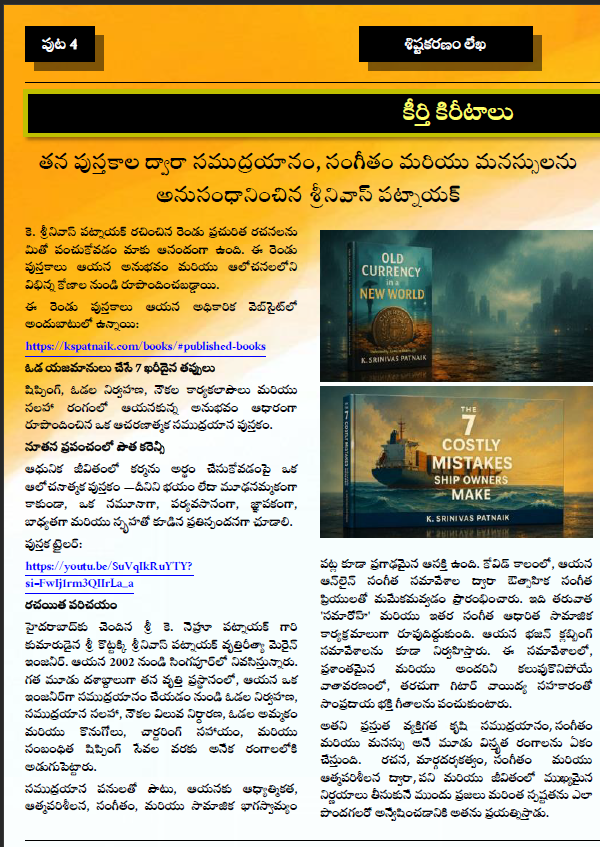
    It was a meaningful moment to see my two published books featured in the July 2026 issue of Sistakaranam Lekha, under the section Keerthi Kireetalu.

    The article shared details of both books:

    Old Currency in a New World: Understanding Karma in Modern Life

    and

    The 7 Costly Mistakes Ship Owners Make

    For me, this recognition is special because it comes from within the community.

    Sistakaranam Lekha is part of the wider work of Sistakaranam Ikyavedika, a digital community platform that documents and shares community updates, achievements, service initiatives, cultural contributions, newsletters, reports, and related activities.

    To have my books mentioned in that space feels both humbling and encouraging.

    Two Books, Two Dimensions

    These two books come from different parts of my life.

    The 7 Costly Mistakes Ship Owners Make comes from my maritime journey — from sailing as a marine engineer to ship management, ship valuation, advisory, sale and purchase, chartering support, and commercial decision-making.

    It is a practical book written for ship owners, buyers, financiers, brokers, and maritime professionals who wish to avoid costly mistakes before making important commitments.

    Old Currency in a New World comes from another dimension of life — reflection, observation, meditation, personal experience, difficulty, responsibility, and the understanding of Karma in modern life.

    It explores Karma not as fear, punishment, or superstition, but as pattern, consequence, memory, responsibility, and conscious response.

    One book comes from Maritime.

    The other comes from Mind.

    Together, they reflect two important sides of my journey.

    The Article in Lekha

    The Lekha article introduced the books and also briefly referred to my journey as a marine engineer, my years in Singapore, my work in shipping, and my continuing interests in spirituality, self-reflection, music, and community participation.

    It also mentioned the way my present personal direction brings together three broad areas:

    Maritime, Music, and Mind

    This phrase has become increasingly meaningful to me.

    Maritime gives me commercial grounding and professional experience.

    Music gives me connection, healing, and community.

    Mind gives me the space for reflection, clarity, writing, and conscious response.

    English Summary of the Lekha Feature

    The July 2026 issue of Sistakaranam Lekha featured two published books by K. Srinivas Patnaik.

    The article mentions that both books are available through the author’s official website:

    Published Books

    The 7 Costly Mistakes Ship Owners Make

    A practical maritime book based on the author’s experience in shipping, ship management, vessel operations, and maritime advisory work.

    Old Currency in a New World

    A reflective book on understanding Karma in modern life — not as fear or superstition, but as pattern, consequence, memory, responsibility, and conscious response.

    The article also includes the book trailer link and introduces the author as a professional marine engineer who has been living in Singapore since 2002.

    It refers to his journey across shipping, ship management, maritime advisory, ship valuation, sale and purchase, chartering support, and related shipping services.

    Alongside his maritime work, the article notes his interest in spirituality, self-reflection, music, and community participation. It also mentions his involvement in online music sessions during the Covid period, which later developed into Samaroh and other music-based community gatherings, including Bhajan Clubbing.

    The article observes that his present direction brings together three broad areas:

    Maritime, Music, and Mind

    Through writing, mentoring, music, and self-reflection, he seeks to explore how people can gain greater clarity before making important decisions in work and life.

    Gratitude to the Community

    I am sincerely grateful to the Lekha team for carrying this article and for including my work among the community’s achievements.

    I also thank the wider Sistakaranam community, Sistakaranam Ikyavedika, and the people associated with AISKA and related community initiatives for continuing to document, preserve, and share the journeys of individuals across different fields.

    Community recognition is not only about visibility.

    It reminds us that our work belongs to a larger stream of memory, identity, and contribution.

    The Journey Ahead

    Both books are now available through my official website, with links to Kindle, paperback, Amazon, Notion Press, and book trailers.

    Book details and purchase links:

    Published Books

    The full July 2026 issue of Sistakaranam Lekha can also be accessed here:

    July 2026 issue of Sistakaranam Lekha

    I hope these books reach the readers they are meant to reach.

    One is for better maritime decisions.

    The other is for deeper reflection on life’s patterns.

    Grateful for the encouragement.

    — K. Srinivas Patnaik