Tag: Kultiv8

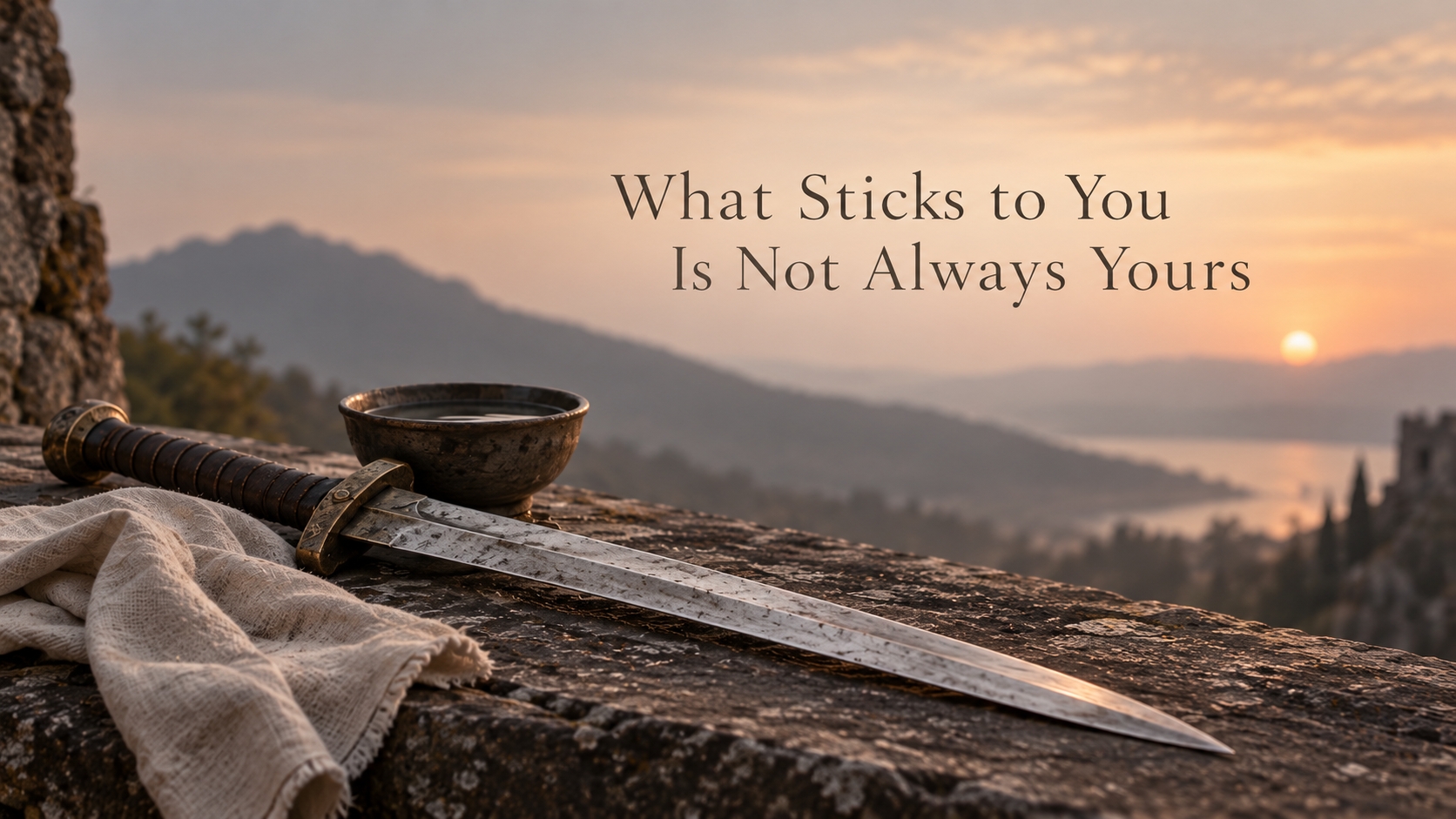
  • What Sticks to You Is Not Always Yours

    What Sticks to You Is Not Always Yours

    Sometimes an idea arrives after a conversation has ended.

    I was speaking with a friend who is passing through a difficult period. We discussed circumstances, responsibility, choices and the weight that certain experiences can leave behind.

    Afterwards, an image came to my mind.

    When a sword is used in battle, there may be blood on its blade.

    The sword has performed its function. But before it can be used again, the blade needs to be cleaned.

    The blood on the sword does not become the sword, nor does it become a part of it.

    In much the same way, when someone cleans a neglected place, handles garbage or enters an unpleasant environment, some of that environment may temporarily remain on the person — the smell, the dust, the dirt.

    That does not mean it belongs to them.

    It simply means they came into contact with it.

    The mistake we often make

    Human beings sometimes do something very different.

    When a difficult experience leaves something behind — guilt, disappointment, embarrassment, anger, financial loss, rejection or the consequences of a wrong decision — we begin to identify ourselves with what has attached itself to us.

    Instead of saying:

    “This happened to me.”

    we gradually begin believing:

    “This is me.”

    That is a very important difference.

    You may have made a mistake.

    You may have trusted somebody you should not have trusted.

    You may have taken a decision that produced an unexpected consequence.

    You may even have knowingly entered a difficult situation because something had to be done.

    Every action has consequences.

    Some of them will leave marks.

    But the mark is not necessarily your identity.

    The more useful question is not whether something unpleasant has attached itself to you.

    Sometimes that is unavoidable.

    The question is:

    What are you going to do with it now?

    Clean the blade.

    Wash the clothes.

    Correct what can be corrected.

    Learn what needs to be learnt.

    Accept whatever genuinely belongs to you.

    And release what does not.

    Then become available again for the next piece of life.

    We are also instruments of creation

    That thought led me somewhere else.

    Look around us.

    Schools, universities, factories, trains, ships, roads, medicines, communication systems, books, music and technology — all of them began somewhere inside a human mind.

    Someone saw something that did not yet exist.

    Someone connected a few dots differently.

    Someone acted.

    Many creators never lived long enough to see the full impact of what they initiated.

    Yet they became conduits through which something entered the world.

    Some creations transformed humanity positively. Others produced unintended consequences. A few may even have caused enormous harm.

    But the underlying phenomenon remains fascinating:

    Human beings are instruments through which ideas become reality.

    We receive.

    We interpret.

    We imagine.

    We act.

    And through those actions, the world changes.

    Perhaps that is where our Old Currency lies

    This is also one of the ways in which I have begun to understand what I call Old Currency.

    Old Currency is not something sitting somewhere outside us waiting to be discovered.

    It is the accumulated inner design we already carry — experience, instinct, perception, intelligence, memory, learning and perhaps something deeper that we do not always know how to describe.

    The difficulty is that we are trying to spend this Old Currency in a very new world.

    The circumstances have changed.

    The language has changed.

    Technology has changed.

    Relationships have changed.

    Work has changed.

    Even our understanding of success, failure, responsibility and identity keeps changing.

    The currency may still have value.

    But we need to learn how to use it differently.

    That requires us to pause occasionally and connect the dots.

    To distinguish between what happened to us and what actually belongs to us.

    To separate experience from identity.

    To recognise the residue of yesterday without allowing it to dictate tomorrow.

    And then to listen carefully enough to that inner design to understand what it may be asking us to create next.

    Clean up. Reconnect. Move again.

    Life will not always allow us to remain untouched.

    If you work, love, build, lead, trust, experiment or attempt something meaningful, you will occasionally get your hands dirty.

    That is part of participating in life.

    The objective cannot be to remain permanently untouched.

    The objective is to know how to return.

    Clean what needs cleaning.

    Repair what needs repairing.

    Learn what needs learning.

    Then reconnect with that part of you which is still capable of imagining, contributing and creating.

    What has attached itself to you does not automatically belong to you.

    And what happened yesterday does not necessarily define what you are capable of creating tomorrow.

    Sometimes we simply need to clean the blade — and become available for the next mission.

    — K. Srinivas Patnaik

    This reflection connects with ideas explored in my book Old Currency in a New World: Understanding Karma in Modern Life.


  • Run the Right Race, Not the Rat Race

    Run the Right Race, Not the Rat Race

    A 1-minute reflection

    Every athlete who enters a race carries the desire to win.

    They may eventually receive gold, silver, bronze — or nothing at all. But no serious participant begins by saying, “I am not here to win.”

    Beyond the prize, recognition, and reward, there is something deeper.

    The inexplicable joy of knowing:

    “I gave myself fully to this.”

    Life is somewhat like that.

    Events keep coming. Races begin and end. Sometimes we win. Sometimes we lose. Sometimes we fall. Sometimes we have to start again.

    But one question remains:

    What is the gold medal we are all running after?

    Honestly, I do not fully know.

    Maybe nobody can define it for another person.

    But there is one quiet clue — the unexplained satisfaction we feel when we are doing something that feels aligned with who we are.

    That inner satisfaction is a guide.

    The problem is, many of us stop listening to it.

    The world pulls us away. Peers distract us. Society pushes us towards comparison, status, packages, and external validation.

    Even young people today often choose their subjects, careers, and futures based mainly on what “package” they may get — not necessarily on what they are naturally designed for.

    But can a sprinter win gold if he or she is unsure, distracted, or running someone else’s race?

    No.

    Each person has their own race to run.

    The purpose of life is not written in one common book.

    It is your journey.

    Your destination.

    Your decision.

    Human instinct is built to race.

    But wisdom lies in this:

    Run the right race.

    Not the rat race.

    Are you running your race, or someone else’s?

  • The Air, the Soul, and the Purpose of Birth

    The Air, the Soul, and the Purpose of Birth

    A 3-minute reflection

    The air around us does not understand the difference between stench and scent.

    It carries both without judgement, without preference, and without knowing what it is carrying.

    But when that air is breathed in by a person, the person immediately recognises whether it carries a bad smell or a beautiful fragrance.

    The air remains detached.

    It only carries.

    In the same way, the soul may carry impressions, tendencies, and subtle ingredients gathered through its journey. It may not judge them as good or bad. It simply carries them.

    But when that soul enters a new body, the individual begins to experience those tendencies through behaviour, likes, dislikes, fears, attractions, reactions, and repeated patterns.

    Some tendencies are easy to understand.

    Some are very difficult to explain.

    For example, my younger son has always had an unusual discomfort with stickers of any kind.

    Once, I had borrowed a friend’s car for a day. When I was dropping my son to school, he refused to sit in the front seat. When I asked him why, he simply pointed to the stickers on the dashboard.

    He is now sixteen years old, and this tendency has been there from his baby days.

    Where does such a tendency come from?

    It is difficult to say.

    But it makes me reflect deeply on how certain impressions may travel with the soul, even before the individual fully understands them.

    The tendencies carried by the soul may remain with a person throughout life. But they are not necessarily permanent in their existing form.

    With sincere effort, they can be observed, refined, converted, and elevated.

    That effort is Sadhana.

    To understand ourselves, we need Swadhyay — self-study.

    To practise what we learn, we need Seva — service.

    And to remain steady in this path, we need Satsang — the company of those who are also walking in the same direction.

    In the modern world, identifying our tendencies has become difficult.

    There is too much distraction, too much noise, and very little space for inner observation.

    But perhaps this is one of the deeper purposes of life.

    The purpose of this birth may not be only to achieve, possess, or succeed externally.

    Perhaps it is also to refine what the soul carries.

    If we carry tendencies that are destructive — hatred, anger, jealousy, cruelty, short temper, or anything that causes pain to ourselves or others — we must make sincere efforts to recognise them and gradually release them.

    If we carry tendencies that are constructive — love, patience, kindness, discipline, compassion, courage, and peace — we must strengthen them, enhance them, and offer them back to existence in a better form.

    So perhaps the purpose of this birth is simple, yet profound.

    To reduce the stench.

    To enhance the fragrance.

    And when the time comes to leave this body, to release a better-quality soul back into the vast space from where it came.

    What fragrance are we cultivating within ourselves?