Author: K. Srinivas Patnaik

  • What Next? One Action at a Time

    What Next? One Action at a Time

    As one task draws to a close, I ask myself a simple question: “What Next?”

    Sometimes the answer is immediately clear. Sometimes the question brings something to my attention that I had overlooked. Occasionally, it leads towards something I had never imagined doing.

    Through my ongoing experience, this question has become a way of bringing attention back to the present moment, recognising what needs doing and carrying out the next action.

    Old Currency in a New World: Understanding Karma in Modern Life draws from my personal experiences, some of which continue to unfold. The book is not a sugarcoated, “once upon a time” fairy-tale version of my past journey. Those who know me very closely know this. These reflections belong to that continuing exploration.

    Seven observations have gradually emerged from asking this question in everyday life.

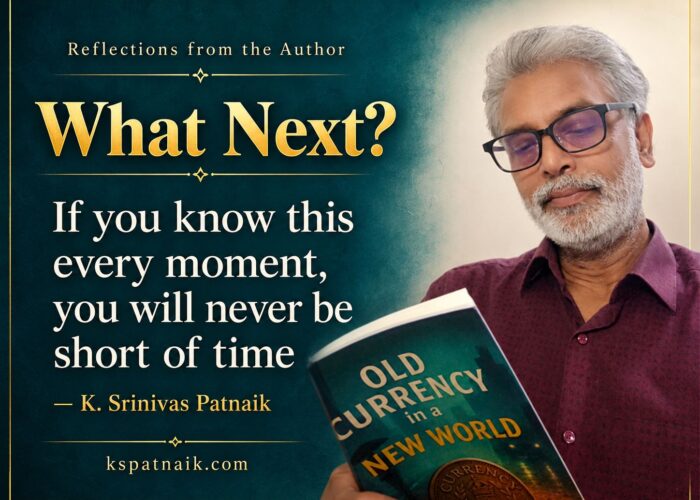
    “If you know this every moment, you will never be short of time.”

    That was the starting insight. For me, it points towards the time that can otherwise disappear into hesitation, divided attention and repeatedly wondering where to begin. When the next action becomes clear, we can give it our attention and proceed.

    The next reflection brought this observation into a simple practice:

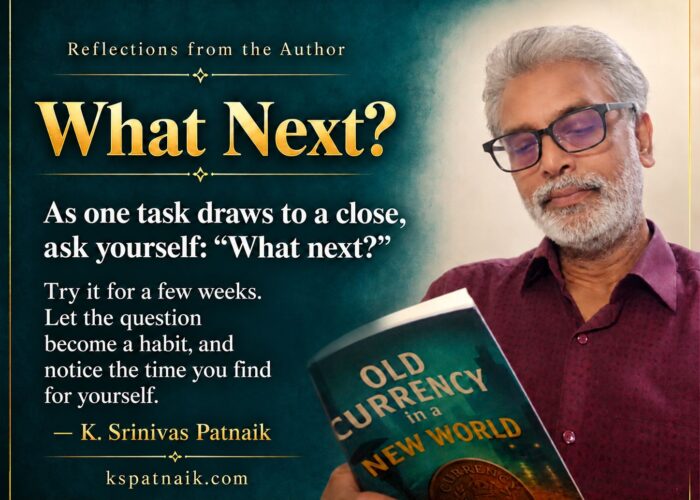
    “As one task draws to a close, ask yourself: ‘What next?’

    Try it for a few weeks. Let the question become a habit, and notice the time you find for yourself.”

    There is something useful about asking as a task approaches completion. We can finish what is in front of us and recognise what requires attention next. Repeated over several weeks, the question becomes familiar. The invitation is to try it and observe what happens in your own day.

    Of course, there are occasions when we already have a long list of things to do. That led to the third reflection:

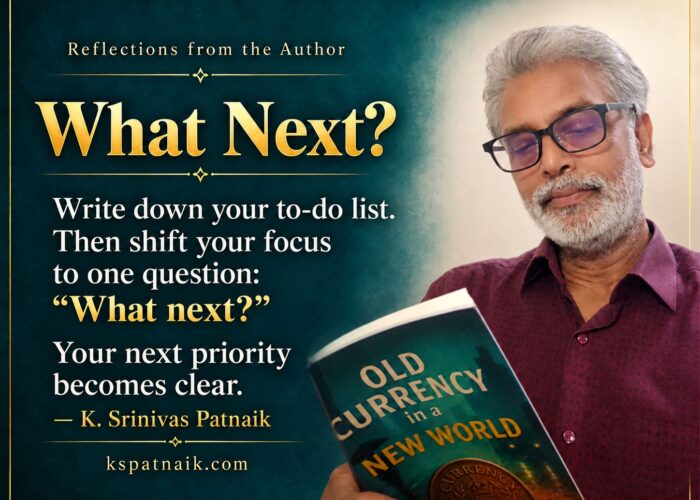
    “Write down your to-do list. Then shift your focus to one question: ‘What next?’ Your next priority becomes clear.”

    Writing things down gives the outstanding tasks a place outside the constant movement of our thoughts. The list holds what needs doing. The question helps us choose where to place our attention now.

    We can keep the result that matters in view while attending to the action that serves it at that moment.

    The same question also has a place when we feel there is nothing to do:

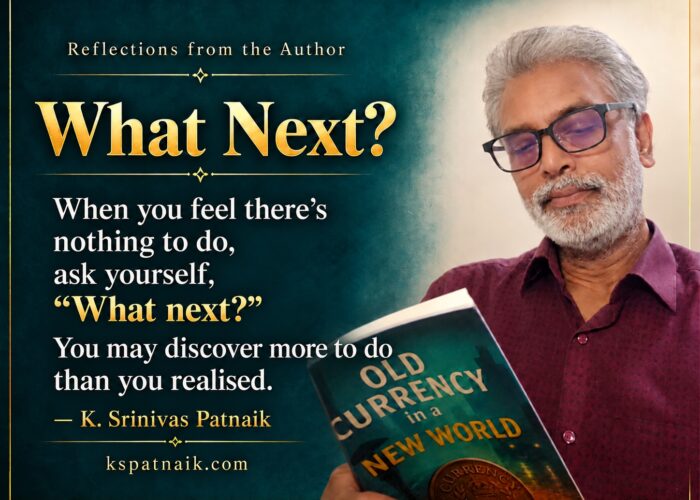
    “When you feel there’s nothing to do, ask yourself, ‘What next?’ You may discover more to do than you realised.”

    Sometimes there is something available that we have simply stopped noticing: an unfinished task, an interest waiting to be explored, a conversation to have or something we could learn. Asking the question can bring such possibilities into view.

    Then there are the more difficult moments:

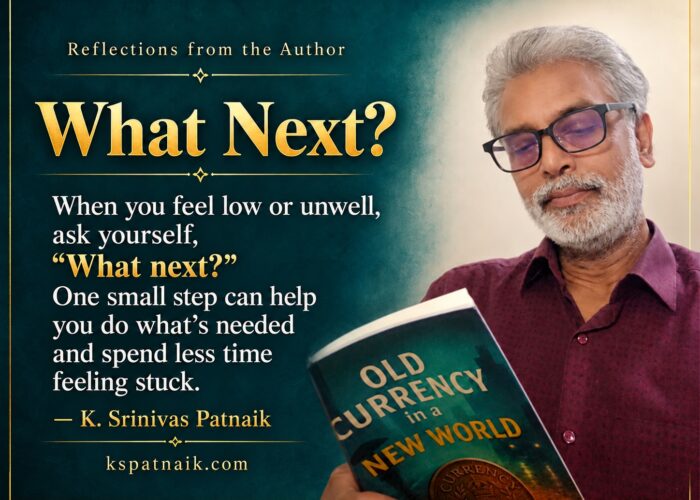
    “When you feel low or unwell, ask yourself, ‘What next?’ One small step can help you do what’s needed and spend less time feeling stuck.”

    In those moments, the next action needs to be manageable and appropriate. It could be a small task, a needed rest or reaching out to someone. We can respond to what the moment requires without mentally carrying everything that remains unfinished.

    As the practice develops, something less predictable may also appear:

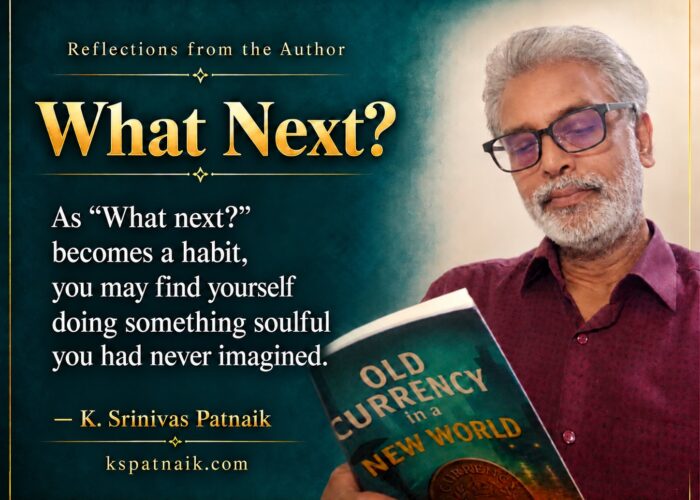
    “As ‘What next?’ becomes a habit, you may find yourself doing something soulful you had never imagined.”

    Even with a clear to-do list, something outside it may call for our attention. An unexpected interest or a quiet urge can become a meaningful experience when we act on it.

    In an earlier reflection, I wondered whether such a small deviation might carry karma’s imprint. “Your inner design beckons.” Those words express the meaning I see in such moments: something personally significant invites our attention before we have fully understood it.

    We can recognise that prompt, give it conscious attention, act on it appropriately and then continue with what needs doing. The experience itself may reveal why it mattered.

    The seventh reflection returns to what regular practice can develop:

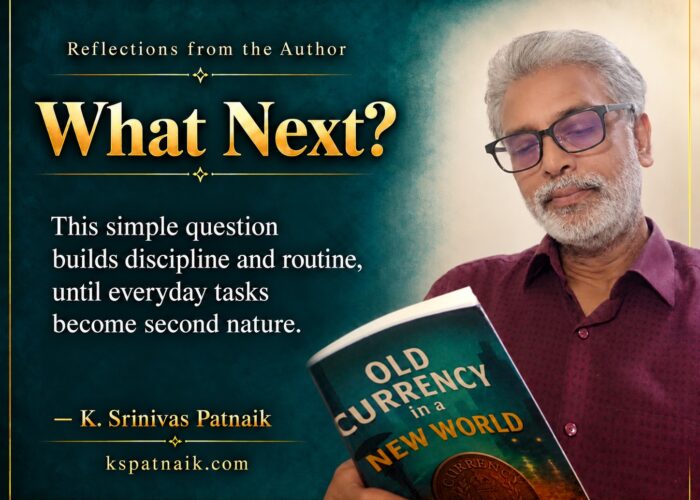
    “This simple question builds discipline and routine, until everyday tasks become second nature.”

    Initially, we practise remembering to ask the question. Gradually, asking and following through can become part of our everyday rhythm. Familiar activities acquire an ease that comes through repetition.

    “Second nature” describes that growing familiarity. The practice becomes part of how we move through the day.

    These seven reflections have also led me to look more closely at how experience, thought and action relate.
    Our respective and respected minds are shaped by different experiences. Even where our assumptions appear similar, the experiences behind them may be quite different.

    I often think of our daily experiences as experiments. We do something, encounter a result and learn from what happens. Some experiments succeed; some fail. Each gives us something further to work with.

    When I speak here of action, I mean consciously chosen bodily activities: typing a message, fetching water, boarding transport or attending a meeting. Reflexes and automatic bodily functions fall outside what I am discussing.

    A thought or decision can lead towards an action. The body carries out the chosen activity. Thinking about sending a message and actually typing and sending it are different stages.

    The context from which we choose an action comes from the mind: what we understand, expect, remember and consider possible. Our experience influences that context, and further action gives us new experience.

    I find it useful to picture experience as information, or data, and the mind as the processor working with it. This is the language through which I explore how what we have lived can influence what we imagine and what we choose to do.

    When I describe thoughts “travelling,” I mean something familiar. I can be sitting in Singapore and mentally walking through my garden in India, drawing on the visual memories of my last visit. My body is here while, in thought, I move through a remembered place.

    Education, knowledge, conversations and further experiences continually add to the material available to us. They widen the playing field for our thoughts.

    A possibility may emerge from that material. We choose to explore it, the body carries out an activity, and the resulting experience gives us something new to understand. The cycle continues.

    Yet sometimes we interrupt that movement by attaching a condition to an otherwise available action.

    “In Order To” creates an invisible link between two independent actions, resulting in a tug of war. You want to do something, “BUT” you need to do something else before that. Doesn’t that sound familiar? Yes, it does. On every such occasion, I have asked the person: “What have these two things got to do with each other? Aren’t they completely independent?”

    The link I am questioning is the one we impose where no practical dependency exists.

    Where one action genuinely requires another, give that requirement its place in the sequence. Completing the prerequisite may itself be the answer to “What Next?”

    For example, if I am waiting for a reply about one matter, I can still complete an independent task. If the reply is essential to a particular activity, I can identify what information is missing, ask for it and attend to another available action while waiting.

    The pending matter has its place. It need not occupy every moment in between.

    “What Next?” actually defuses that “BUT” by maintaining a constant focus on what needs to be done at that moment. Those actions are not linked; they are simply actions that need to be done at that moment. Executed, done and dusted… move on!

    The question brings attention back to what is available now. We can choose an action, carry it out, observe the result and learn from the experience.

    Over time, this can develop into a rhythm: clearer priorities, familiar routines and greater openness to something meaningful we had not anticipated.

    Try it for a few weeks. Write down what needs doing. As one task draws to a close, ask the question. When you feel stuck, look for a manageable step. When an unexpected possibility appears, give it conscious consideration.

    Notice what gets completed, what you learn and what becomes clearer through doing.

    As this reflection draws to a close, ask yourself:

    “What Next?”
  • What Sticks to You Is Not Always Yours

    What Sticks to You Is Not Always Yours

    Sometimes an idea arrives after a conversation has ended.

    I was speaking with a friend who is passing through a difficult period. We discussed circumstances, responsibility, choices and the weight that certain experiences can leave behind.

    Afterwards, an image came to my mind.

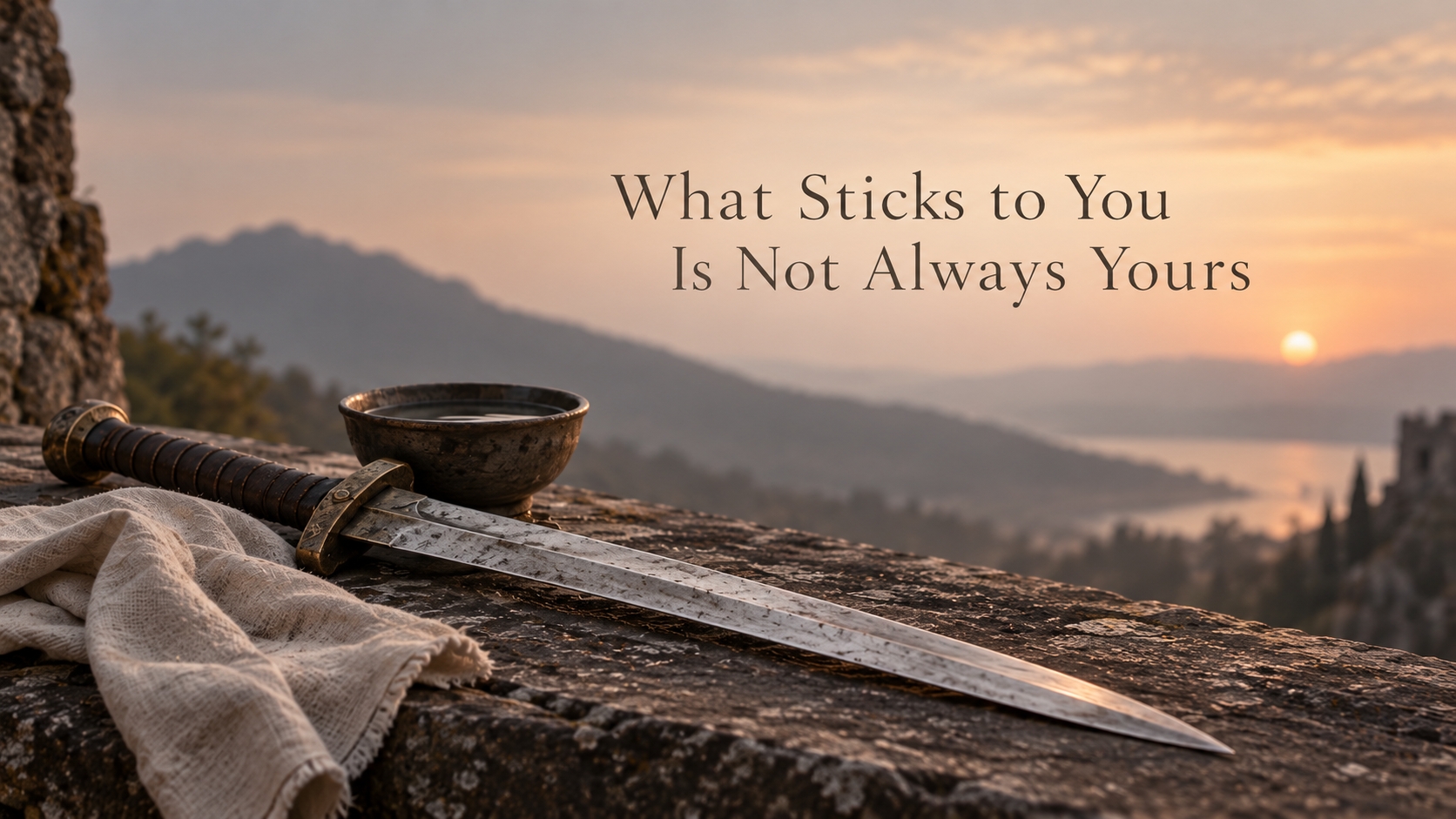
    When a sword is used in battle, there may be blood on its blade.

    The sword has performed its function. But before it can be used again, the blade needs to be cleaned.

    The blood on the sword does not become the sword, nor does it become a part of it.

    In much the same way, when someone cleans a neglected place, handles garbage or enters an unpleasant environment, some of that environment may temporarily remain on the person — the smell, the dust, the dirt.

    That does not mean it belongs to them.

    It simply means they came into contact with it.

    The mistake we often make

    Human beings sometimes do something very different.

    When a difficult experience leaves something behind — guilt, disappointment, embarrassment, anger, financial loss, rejection or the consequences of a wrong decision — we begin to identify ourselves with what has attached itself to us.

    Instead of saying:

    “This happened to me.”

    we gradually begin believing:

    “This is me.”

    That is a very important difference.

    You may have made a mistake.

    You may have trusted somebody you should not have trusted.

    You may have taken a decision that produced an unexpected consequence.

    You may even have knowingly entered a difficult situation because something had to be done.

    Every action has consequences.

    Some of them will leave marks.

    But the mark is not necessarily your identity.

    The more useful question is not whether something unpleasant has attached itself to you.

    Sometimes that is unavoidable.

    The question is:

    What are you going to do with it now?

    Clean the blade.

    Wash the clothes.

    Correct what can be corrected.

    Learn what needs to be learnt.

    Accept whatever genuinely belongs to you.

    And release what does not.

    Then become available again for the next piece of life.

    We are also instruments of creation

    That thought led me somewhere else.

    Look around us.

    Schools, universities, factories, trains, ships, roads, medicines, communication systems, books, music and technology — all of them began somewhere inside a human mind.

    Someone saw something that did not yet exist.

    Someone connected a few dots differently.

    Someone acted.

    Many creators never lived long enough to see the full impact of what they initiated.

    Yet they became conduits through which something entered the world.

    Some creations transformed humanity positively. Others produced unintended consequences. A few may even have caused enormous harm.

    But the underlying phenomenon remains fascinating:

    Human beings are instruments through which ideas become reality.

    We receive.

    We interpret.

    We imagine.

    We act.

    And through those actions, the world changes.

    Perhaps that is where our Old Currency lies

    This is also one of the ways in which I have begun to understand what I call Old Currency.

    Old Currency is not something sitting somewhere outside us waiting to be discovered.

    It is the accumulated inner design we already carry — experience, instinct, perception, intelligence, memory, learning and perhaps something deeper that we do not always know how to describe.

    The difficulty is that we are trying to spend this Old Currency in a very new world.

    The circumstances have changed.

    The language has changed.

    Technology has changed.

    Relationships have changed.

    Work has changed.

    Even our understanding of success, failure, responsibility and identity keeps changing.

    The currency may still have value.

    But we need to learn how to use it differently.

    That requires us to pause occasionally and connect the dots.

    To distinguish between what happened to us and what actually belongs to us.

    To separate experience from identity.

    To recognise the residue of yesterday without allowing it to dictate tomorrow.

    And then to listen carefully enough to that inner design to understand what it may be asking us to create next.

    Clean up. Reconnect. Move again.

    Life will not always allow us to remain untouched.

    If you work, love, build, lead, trust, experiment or attempt something meaningful, you will occasionally get your hands dirty.

    That is part of participating in life.

    The objective cannot be to remain permanently untouched.

    The objective is to know how to return.

    Clean what needs cleaning.

    Repair what needs repairing.

    Learn what needs learning.

    Then reconnect with that part of you which is still capable of imagining, contributing and creating.

    What has attached itself to you does not automatically belong to you.

    And what happened yesterday does not necessarily define what you are capable of creating tomorrow.

    Sometimes we simply need to clean the blade — and become available for the next mission.

    — K. Srinivas Patnaik

    This reflection connects with ideas explored in my book Old Currency in a New World: Understanding Karma in Modern Life.

  • A Community Recognition in Sistakaranam Lekha

    A Community Recognition in Sistakaranam Lekha

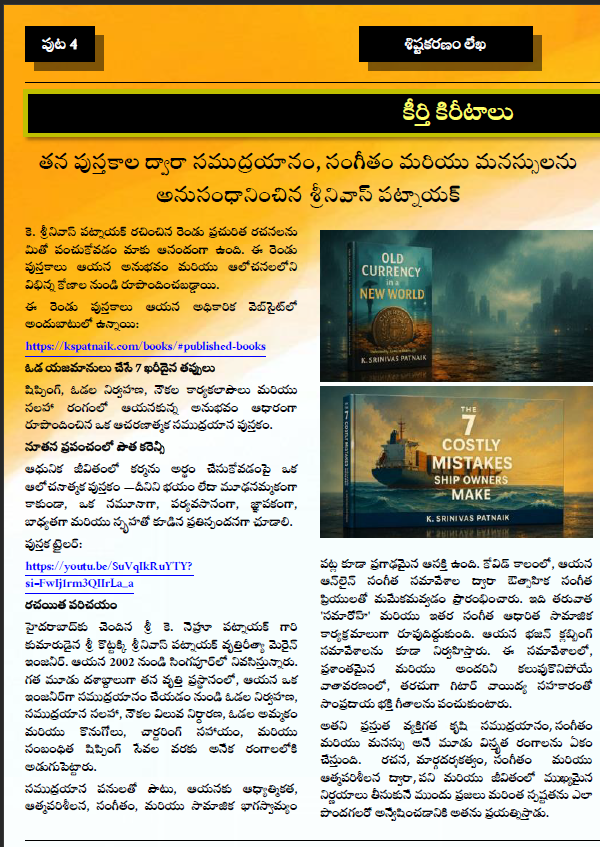
    It was a meaningful moment to see my two published books featured in the July 2026 issue of Sistakaranam Lekha, under the section Keerthi Kireetalu.

    The article shared details of both books:

    Old Currency in a New World: Understanding Karma in Modern Life

    and

    The 7 Costly Mistakes Ship Owners Make

    For me, this recognition is special because it comes from within the community.

    Sistakaranam Lekha is part of the wider work of Sistakaranam Ikyavedika, a digital community platform that documents and shares community updates, achievements, service initiatives, cultural contributions, newsletters, reports, and related activities.

    To have my books mentioned in that space feels both humbling and encouraging.

    Two Books, Two Dimensions

    These two books come from different parts of my life.

    The 7 Costly Mistakes Ship Owners Make comes from my maritime journey — from sailing as a marine engineer to ship management, ship valuation, advisory, sale and purchase, chartering support, and commercial decision-making.

    It is a practical book written for ship owners, buyers, financiers, brokers, and maritime professionals who wish to avoid costly mistakes before making important commitments.

    Old Currency in a New World comes from another dimension of life — reflection, observation, meditation, personal experience, difficulty, responsibility, and the understanding of Karma in modern life.

    It explores Karma not as fear, punishment, or superstition, but as pattern, consequence, memory, responsibility, and conscious response.

    One book comes from Maritime.

    The other comes from Mind.

    Together, they reflect two important sides of my journey.

    The Article in Lekha

    The Lekha article introduced the books and also briefly referred to my journey as a marine engineer, my years in Singapore, my work in shipping, and my continuing interests in spirituality, self-reflection, music, and community participation.

    It also mentioned the way my present personal direction brings together three broad areas:

    Maritime, Music, and Mind

    This phrase has become increasingly meaningful to me.

    Maritime gives me commercial grounding and professional experience.

    Music gives me connection, healing, and community.

    Mind gives me the space for reflection, clarity, writing, and conscious response.

    English Summary of the Lekha Feature

    The July 2026 issue of Sistakaranam Lekha featured two published books by K. Srinivas Patnaik.

    The article mentions that both books are available through the author’s official website:

    Published Books

    The 7 Costly Mistakes Ship Owners Make

    A practical maritime book based on the author’s experience in shipping, ship management, vessel operations, and maritime advisory work.

    Old Currency in a New World

    A reflective book on understanding Karma in modern life — not as fear or superstition, but as pattern, consequence, memory, responsibility, and conscious response.

    The article also includes the book trailer link and introduces the author as a professional marine engineer who has been living in Singapore since 2002.

    It refers to his journey across shipping, ship management, maritime advisory, ship valuation, sale and purchase, chartering support, and related shipping services.

    Alongside his maritime work, the article notes his interest in spirituality, self-reflection, music, and community participation. It also mentions his involvement in online music sessions during the Covid period, which later developed into Samaroh and other music-based community gatherings, including Bhajan Clubbing.

    The article observes that his present direction brings together three broad areas:

    Maritime, Music, and Mind

    Through writing, mentoring, music, and self-reflection, he seeks to explore how people can gain greater clarity before making important decisions in work and life.

    Gratitude to the Community

    I am sincerely grateful to the Lekha team for carrying this article and for including my work among the community’s achievements.

    I also thank the wider Sistakaranam community, Sistakaranam Ikyavedika, and the people associated with AISKA and related community initiatives for continuing to document, preserve, and share the journeys of individuals across different fields.

    Community recognition is not only about visibility.

    It reminds us that our work belongs to a larger stream of memory, identity, and contribution.

    The Journey Ahead

    Both books are now available through my official website, with links to Kindle, paperback, Amazon, Notion Press, and book trailers.

    Book details and purchase links:

    Published Books

    The full July 2026 issue of Sistakaranam Lekha can also be accessed here:

    July 2026 issue of Sistakaranam Lekha

    I hope these books reach the readers they are meant to reach.

    One is for better maritime decisions.

    The other is for deeper reflection on life’s patterns.

    Grateful for the encouragement.

    — K. Srinivas Patnaik

  • The First Paperback Copy Landed in Singapore

    The First Paperback Copy Landed in Singapore

    A quiet gesture from a friend, and a moment that made the book feel real.

    Some moments arrive quietly, but stay for a long time.

    Today, I received a photograph that became one such moment for me.

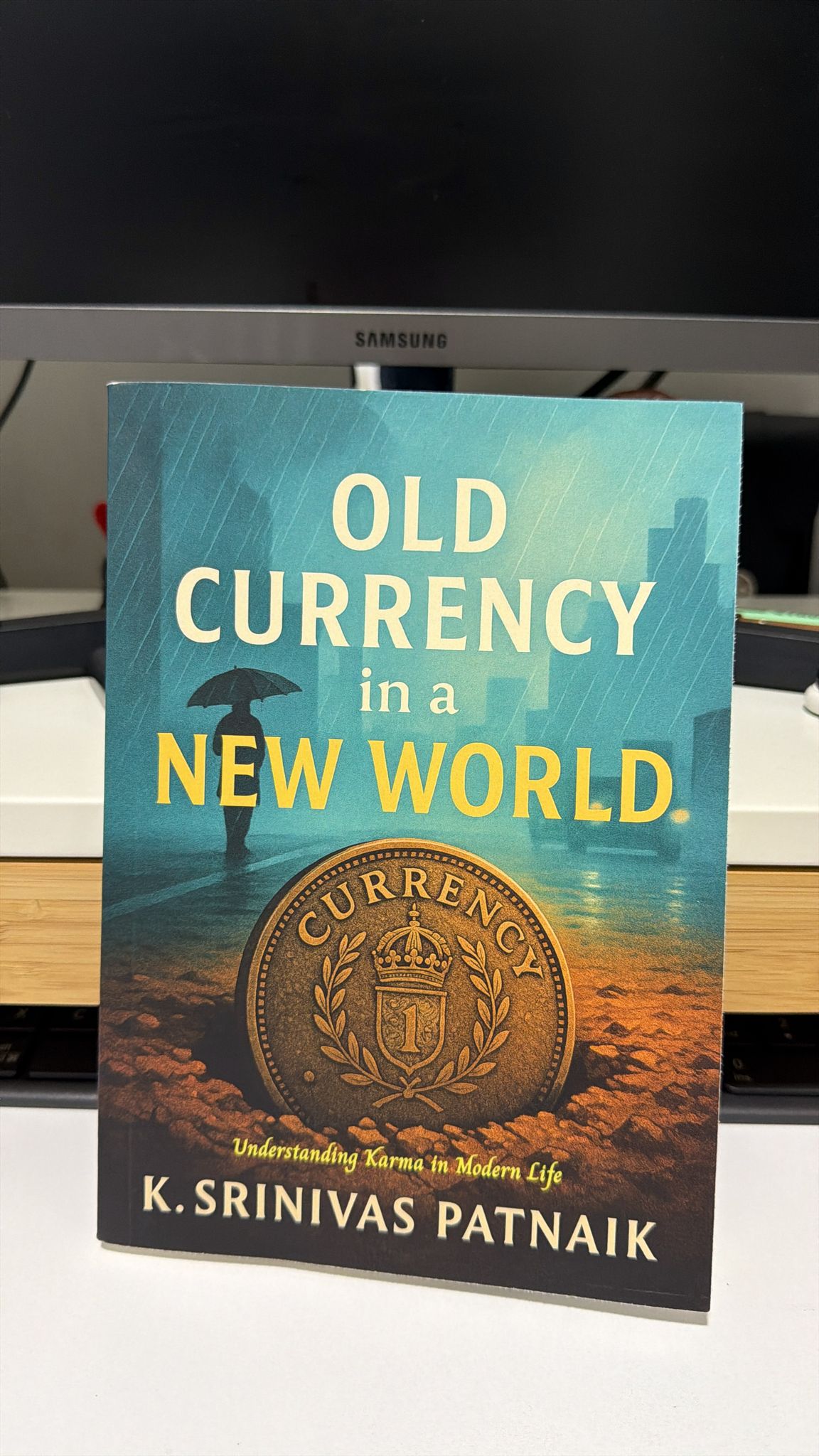
    The first paperback copy of my book, Old Currency in a New World: Understanding Karma in Modern Life, has landed in Singapore. And it came as a complete surprise.

    A dear friend, Hiral Kakaiya, quietly ordered the book and had it delivered here. I had no idea he had done this. I had not even sent him the promotional message personally.

    That is what made the gesture even more meaningful.

    I first met Hiral a few months ago at Yummy Punjabi. We were there for a Samaroh session, and he had come with his family for dinner. His children joined in impromptu, music happened naturally, and somehow a connection was formed.

    Later, we met again for coffee at Cafe Wabi Sabi in Joo Chiat. What was meant to be a short meeting before my rehearsal turned into more than an hour of deeply meaningful conversation. We spoke about life, work, family, clarity, responsibility, and the journeys that quietly shape us.

    Time seemed to disappear.

    The next morning, I remember telling him that listening to his life story gave me more conviction in my own learnings. He responded with something that stayed with me:

    “It was a rare conversation, the kind where two stories meet and something clicks.”

    That sentence beautifully captured what I had also felt.

    During that meeting, I had mentioned that my book on Karma was about to be published. After that, life moved on. The book was launched. I shared it on social media. But I somehow missed sending the link to him directly.

    Yet, he noticed it.

    He picked it up from social media, ordered the paperback quietly, and today sent me a photograph of the first physical copy that has reached Singapore.

    For an author, a physical book is different.

    A manuscript can sit on a screen. A thought can live in notes. A chapter can be revised endlessly. But when a book reaches someone’s hand, something changes. It becomes real in a new way.

    A thought that lived quietly within me for many years has now taken the form of a printed book, travelled across borders, and arrived in Singapore through the kindness of a friend.

    That is not merely a delivery.

    It is a small but deeply meaningful affirmation.

    Thank you, Hiral, for this thoughtful gesture, your encouragement, and for making the first paperback arrival in Singapore so memorable.

    I will always remember this photograph.

    Old Currency in a New World
    A book for reflection, not fear.

    — K. Srinivas Patnaik

  • The Soldier and the Ammunition

    A 1-minute archive reflection

    Archive note:
    This reflection was originally written during the COVID period on my earlier Facebook page, Change Your Thoughts & Make Your Living Better – CYT. The original title was Core-On-Arm-R. It is preserved here as an archive reflection from that time, with light editing for clarity.

    Who fights the war — the soldier or the ammunition?

    Ammunition has no value unless there is a soldier to use it.

    A war may still be fought with limited ammunition, but ammunition alone cannot fight the war.

    And when ammunition is placed in the hands of a better-prepared soldier, it becomes far more effective.

    During the COVID period, this thought came to me very strongly.

    The virus was the enemy.

    The body was the soldier.

    Vaccines, medicines, masks, gloves, sanitisers, and protective equipment were the ammunition.

    So where does the real strength lie?

    It lies in the soldier.

    The body must be cared for. Immunity, fitness, rest, discipline, and alertness matter. They do not replace medical care or responsible precautions, but they support the person who has to face the situation.

    A weak soldier with strong ammunition may still struggle.

    A stronger soldier can use available protection more effectively.

    There is also one important lesson from martial arts and physical training.

    The first lesson is not always to fight.

    Often, the first lesson is to avoid unnecessary combat.

    Run.

    Take cover.

    Stay away from danger where possible.

    Engage only when necessary.

    That was true during the pandemic as well.

    Use the available protection. Follow the necessary precautions. Seek medical guidance when needed. But also respect the body that has to carry you through the battle.

    The war outside may not always be in our control.

    But preparing the soldier within remains our responsibility.

  • Run the Right Race, Not the Rat Race

    Run the Right Race, Not the Rat Race

    A 1-minute reflection

    Every athlete who enters a race carries the desire to win.

    They may eventually receive gold, silver, bronze — or nothing at all. But no serious participant begins by saying, “I am not here to win.”

    Beyond the prize, recognition, and reward, there is something deeper.

    The inexplicable joy of knowing:

    “I gave myself fully to this.”

    Life is somewhat like that.

    Events keep coming. Races begin and end. Sometimes we win. Sometimes we lose. Sometimes we fall. Sometimes we have to start again.

    But one question remains:

    What is the gold medal we are all running after?

    Honestly, I do not fully know.

    Maybe nobody can define it for another person.

    But there is one quiet clue — the unexplained satisfaction we feel when we are doing something that feels aligned with who we are.

    That inner satisfaction is a guide.

    The problem is, many of us stop listening to it.

    The world pulls us away. Peers distract us. Society pushes us towards comparison, status, packages, and external validation.

    Even young people today often choose their subjects, careers, and futures based mainly on what “package” they may get — not necessarily on what they are naturally designed for.

    But can a sprinter win gold if he or she is unsure, distracted, or running someone else’s race?

    No.

    Each person has their own race to run.

    The purpose of life is not written in one common book.

    It is your journey.

    Your destination.

    Your decision.

    Human instinct is built to race.

    But wisdom lies in this:

    Run the right race.

    Not the rat race.

    Are you running your race, or someone else’s?

  • The Air, the Soul, and the Purpose of Birth

    The Air, the Soul, and the Purpose of Birth

    A 3-minute reflection

    The air around us does not understand the difference between stench and scent.

    It carries both without judgement, without preference, and without knowing what it is carrying.

    But when that air is breathed in by a person, the person immediately recognises whether it carries a bad smell or a beautiful fragrance.

    The air remains detached.

    It only carries.

    In the same way, the soul may carry impressions, tendencies, and subtle ingredients gathered through its journey. It may not judge them as good or bad. It simply carries them.

    But when that soul enters a new body, the individual begins to experience those tendencies through behaviour, likes, dislikes, fears, attractions, reactions, and repeated patterns.

    Some tendencies are easy to understand.

    Some are very difficult to explain.

    For example, my younger son has always had an unusual discomfort with stickers of any kind.

    Once, I had borrowed a friend’s car for a day. When I was dropping my son to school, he refused to sit in the front seat. When I asked him why, he simply pointed to the stickers on the dashboard.

    He is now sixteen years old, and this tendency has been there from his baby days.

    Where does such a tendency come from?

    It is difficult to say.

    But it makes me reflect deeply on how certain impressions may travel with the soul, even before the individual fully understands them.

    The tendencies carried by the soul may remain with a person throughout life. But they are not necessarily permanent in their existing form.

    With sincere effort, they can be observed, refined, converted, and elevated.

    That effort is Sadhana.

    To understand ourselves, we need Swadhyay — self-study.

    To practise what we learn, we need Seva — service.

    And to remain steady in this path, we need Satsang — the company of those who are also walking in the same direction.

    In the modern world, identifying our tendencies has become difficult.

    There is too much distraction, too much noise, and very little space for inner observation.

    But perhaps this is one of the deeper purposes of life.

    The purpose of this birth may not be only to achieve, possess, or succeed externally.

    Perhaps it is also to refine what the soul carries.

    If we carry tendencies that are destructive — hatred, anger, jealousy, cruelty, short temper, or anything that causes pain to ourselves or others — we must make sincere efforts to recognise them and gradually release them.

    If we carry tendencies that are constructive — love, patience, kindness, discipline, compassion, courage, and peace — we must strengthen them, enhance them, and offer them back to existence in a better form.

    So perhaps the purpose of this birth is simple, yet profound.

    To reduce the stench.

    To enhance the fragrance.

    And when the time comes to leave this body, to release a better-quality soul back into the vast space from where it came.

    What fragrance are we cultivating within ourselves?

  • The Body Speaks Early. We Often Listen Late.

    A calm person sitting near a window with tea and a notebook, reflecting on early body signals and wellness awareness.
    The body often speaks before we are ready to listen.

    This happens more often than we realise.

    When discomfort appears, we usually rush to deal with the symptom.

    Pain.
    Fever.
    Running nose.
    Itching.
    Swelling.
    Tiredness.
    Stiffness.
    Poor sleep.
    Low energy.

    These are the things we feel.

    But very often, these are not the beginning of the problem. They are the visible or felt outcome of something that may already be happening inside the body.

    Over the years, most of us have been trained to first reduce discomfort. If there is pain, we want the pain to stop. If there is fever, we want the fever to come down. If there is itching, we want the itching to disappear.

    There is nothing wrong with seeking relief.

    There is also nothing wrong with going to a doctor. In fact, when symptoms are serious, persistent, unusual, or frightening, proper medical advice is important.

    But along with treating the discomfort, I feel we should also pause and ask a deeper question:

    What could have triggered this?

    Many times, we do not even ask that question.

    We simply say, “I am not feeling well,” and then immediately look for something to make the feeling go away.

    But are we truly unwell in the way the mind imagines?

    Sometimes the mind creates its own explanation based on past experience. A pain in one place may remind us of an old problem. A skin irritation may trigger fear. A sudden discomfort may make us assume the worst.

    But the same symptom can come from different causes.

    A headache may not always mean the same thing.
    Body pain may not always mean the same thing.
    Skin irritation may not always mean the same thing.
    Tiredness may not always mean the same thing.

    Something may be happening inside the body that we cannot see.

    And because we cannot see it, we often start assuming.

    That is where confusion begins.

    What I am slowly learning is this:

    Before we panic, and even while we seek proper medical guidance where needed, we should also observe our own recent life.

    What happened in the last few days?

    Did we sleep badly?
    Did we skip meals?
    Did we eat too much?
    Did we eat something unusual?
    Were we under pressure?
    Did we drink enough water?
    Were we sitting too long?
    Did we stop walking or moving?
    Were we emotionally disturbed?
    Did we ignore rest?
    Did we push the body beyond its usual rhythm?

    Sometimes the body is not attacking us.

    Sometimes it is only reporting what we have been doing to it.

    This does not mean we should self-diagnose carelessly.

    It simply means we should become more aware.

    There is a difference between panic and awareness.

    Panic says:
    “Something is wrong. I must react immediately.”

    Awareness says:
    “Something is being shown. Let me observe carefully.”

    The body has its own language.

    It speaks through energy, sleep, appetite, digestion, skin, pain, mood, stiffness, recovery, and many small signals that we often dismiss.

    In my own journey, I learnt that the body does not usually become serious in one day.

    It whispers first.

    Then it repeats.

    Then it raises its voice.

    And when we still do not listen, it may finally force us to stop.

    That is why I believe wellbeing begins much earlier than treatment.

    It begins with observation.

    It begins with tolerance.

    It begins with asking better questions.

    It begins with remembering what we did to the body before blaming the body for reacting.

    This page is not about fear.

    It is about listening earlier.

    Because the body often speaks early.

    We simply listen late.

    This reflection is part of my wider journey through wellness, awareness, and daily discipline.

    The body often speaks early.

    We simply listen late.

    Wellbeing begins with awareness.

  • Jam & Learn — An Example of Inspiration

    From the Archives

    This reflection was originally written on 26 March 2010 as a Facebook Note and was last edited on 6 May 2021. It has been lightly refined and republished here for clarity and readability, while preserving the original thought, feeling, gratitude, and intent.

    Jam & Learn is an extension of my hobby — playing the guitar for fun, not as a profession.

    As most of you know, I am a full-time marine engineer, now managing ships from ashore. But throughout my sailing years, I carried my guitar with me on every ship I sailed on.

    My First Ship

    I was in Kolkata — Calcutta then — staying at Port View Guest House. I am amazed that I could remember that name within a few seconds.

    My batchmate Pandey was also there, waiting to join his ship, and was staying in the same guest house.

    He was the one who inspired me to carry the guitar on my first ship.

    I was very apprehensive. I thought my superiors may not like it, and I might probably get a good ragging for carrying a guitar on board.

    But Pandey advised me to carry it quietly.

    “Take it into your room,” he said, “and don’t mention it outside for at least six months. After that, it will be fine.”

    So I covered the guitar in a plastic bag and cloth, carried it straight to my cabin, and kept it with me.

    Of course, my father was the one who had carried the guitar all the way from Nagpur. He was posted there at the time I was joining my first ship. He brought it to Kolkata when he came to see me off.

    I was joining my first SCI ship at Chennai.

    Ever Since

    Ever since then, I have carried my guitar on all ships.

    It is not that I played every day, but I loved having it with me.

    There were moments at sea when you would suddenly yearn to play a few notes of a wonderful song. And if the guitar was not there at that moment, it felt deeply disappointing.

    On average, I probably strummed or played at least once a week.

    Of course, once my shipmates came to know about the guitar, they would carry it all the way to parties, and we would jam on Hindi melodies of every kind.

    There are so many wonderful compositions by our esteemed music directors. Some songs simply refuse to leave you.

    I will write more about the associations and inspirations that kept me going until I finally met my only Guru, Shri Radha Vijayan of Mirra Fine Arts, Singapore.

    Please do visit the music school’s website and see how he has created a world of music single-handedly, with soulful dedication to the guitar.

    He is a wonderful human being and can inspire you even through his quiet and unassuming presence.

    I have known him for more than four years, and I could write lengthy essays on each meeting we have had.

    Jam & Learn is a practical example of how far inspiration can take you.

    It is still just the beginning.

    Thank you, Sir, for being there.

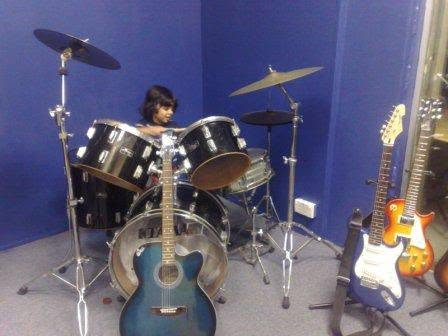
    Little drummer in “Papa’s studio.”

    The little drummer, Vahein, jumps whenever he hears that we are going to “Papa’s studio.” That is what he calls it.

    I have attached his picture with this note.

    More in my next.

    Until then, please hear the music even in silence.

    Try it.

    You can.

    Have fun.

    Cheers,
    Srinivas

  • Before My Glass of Coke Became Empty

    From the Archives

    This reflection was originally published on 3 April 2010 as a Facebook Note and was last edited on 6 May 2021. It has been lightly refined and republished here for clarity and readability, while preserving the original thought, feeling, humour, and intent.

    It was during the final year of DMET, when I had just started learning to play the guitar.

    I am not sure how I sounded in those days, but this bunch of batchmates made me feel like a professional musician. They treated me like a celebrity and made sure I was always taken care of.

    In fact, I used to get stuffed with Coke because someone in the group would somehow notice that Patti’s glass was getting empty.

    And before my glass of Coke became empty, it would get filled up again.

    Come on guys, I miss you all.

    Tutu, Balda, Vohra, Deepak, Shivi, Sunil, Pandey, Gohil, DK — they were my early and only audience. What a wonderful lot of admirers they were.

    They probably never heard what I was actually playing, because they were too busy getting intoxicated. I, on the other hand, was an excessive passive smoker in those days, staying around these guys while they smoked, laughed, sang, and enjoyed themselves.

    Somehow, I loved being with them.

    I kept playing whatever few notes or chords I knew.

    Tutu was a wonder kid when it came to tunes. He could pick up the right notes and immediately catch you if you went off track.

    I remember him playing bass with us in the band. He fretted it out, picked up the notes, and figured out the trick to play the prelude piece of Saagar Kinaare. I still play it almost the same way even today.

    Later, I struggled and picked up the prelude for Pal Pal Dil Ke Paas.

    I used to play for these guys till the early hours of the morning. For me, it was also a challenge to play in dim light without looking at the guitar’s fretboard.

    It had been only about six months since I had seriously started playing, and I was fascinated whenever I saw guitarists play without even looking at the instrument.

    The band group of my seniors was a treat to watch. Bernard was a genius. He is now in Miami with Aalborg, if I remember correctly.

    Those were the days when these guys would fill up my glass of Coke and request me to continue strumming notes for them.

    At times, they even used to bring along extra stock. I realised that only later.

    But I enjoyed every moment of playing the guitar for this amazing bunch of friends.

    Tutu used to ask me several times:

    “Abe, daaru peeta nahin, phir itna der bajata kaise hai?”

    I do not have the answer to this day.

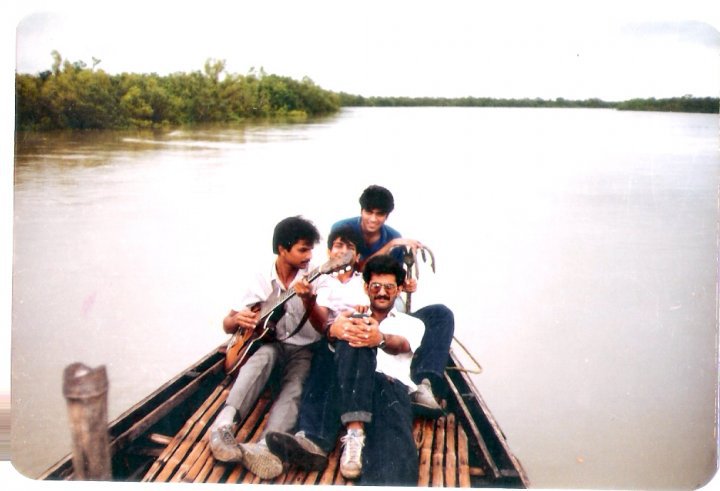
    Final year DMET memories from 1990 — on a boat in the Sunderbans Delta, with guitar, songs, and batchmates.

    In 2010, I had written that I wanted to make a new composition for the 1990 batch.

    The last one I had composed in memory of late P.D. — such a wonderful person he was — was called How I Wish You Were Here. The lyrics were written by Vohra.

    I composed it using a simple chord progression that I had learnt from Amit Dutta of Shiva fame.

    Some memories remain alive not because they were grand, but because they were shared with the right people.

    A guitar. A dimly lit room. A glass of Coke. A few friends. A few songs.

    And a feeling that still remains.

    Say cheese and keep smiling.

    Srinivas
    Patti, for all of them