
As one task draws to a close, I ask myself a simple question: “What Next?”
Sometimes the answer is immediately clear. Sometimes the question brings something to my attention that I had overlooked. Occasionally, it leads towards something I had never imagined doing.
Through my ongoing experience, this question has become a way of bringing attention back to the present moment, recognising what needs doing and carrying out the next action.
Old Currency in a New World: Understanding Karma in Modern Life draws from my personal experiences, some of which continue to unfold. The book is not a sugarcoated, “once upon a time” fairy-tale version of my past journey. Those who know me very closely know this. These reflections belong to that continuing exploration.
Seven observations have gradually emerged from asking this question in everyday life.
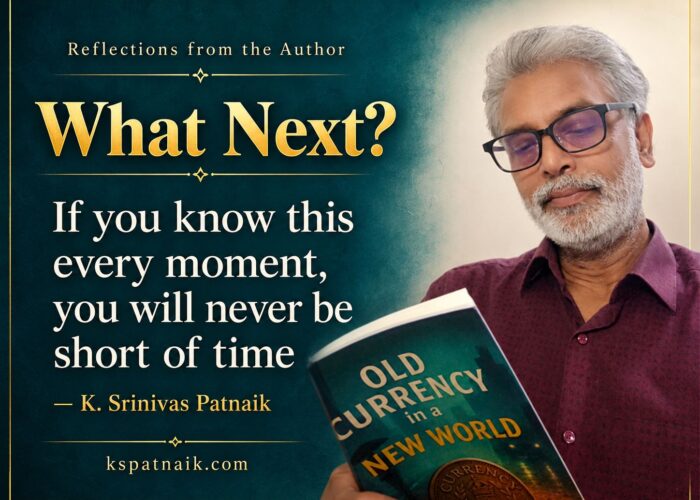
“If you know this every moment, you will never be short of time.”
That was the starting insight. For me, it points towards the time that can otherwise disappear into hesitation, divided attention and repeatedly wondering where to begin. When the next action becomes clear, we can give it our attention and proceed.
The next reflection brought this observation into a simple practice:
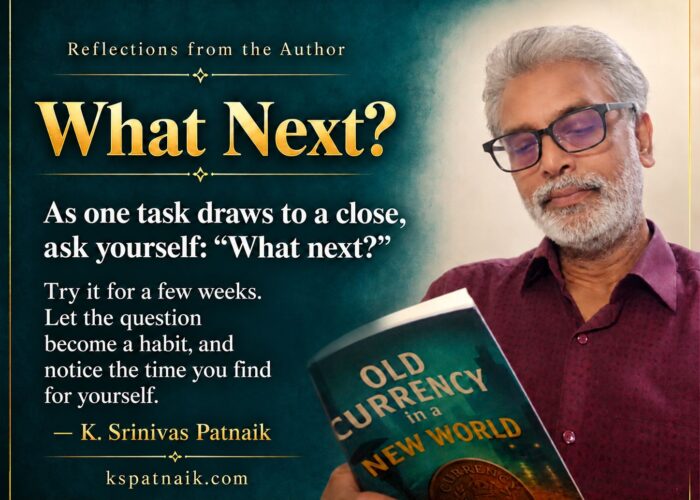
“As one task draws to a close, ask yourself: ‘What next?’
Try it for a few weeks. Let the question become a habit, and notice the time you find for yourself.”
There is something useful about asking as a task approaches completion. We can finish what is in front of us and recognise what requires attention next. Repeated over several weeks, the question becomes familiar. The invitation is to try it and observe what happens in your own day.
Of course, there are occasions when we already have a long list of things to do. That led to the third reflection:
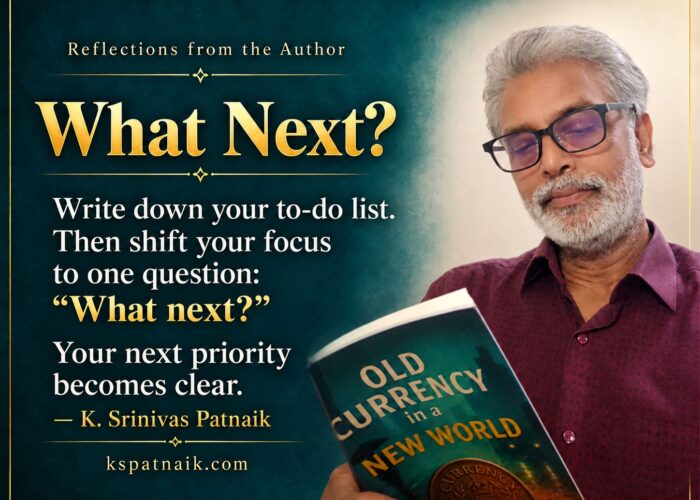
“Write down your to-do list. Then shift your focus to one question: ‘What next?’ Your next priority becomes clear.”
Writing things down gives the outstanding tasks a place outside the constant movement of our thoughts. The list holds what needs doing. The question helps us choose where to place our attention now.
We can keep the result that matters in view while attending to the action that serves it at that moment.
The same question also has a place when we feel there is nothing to do:
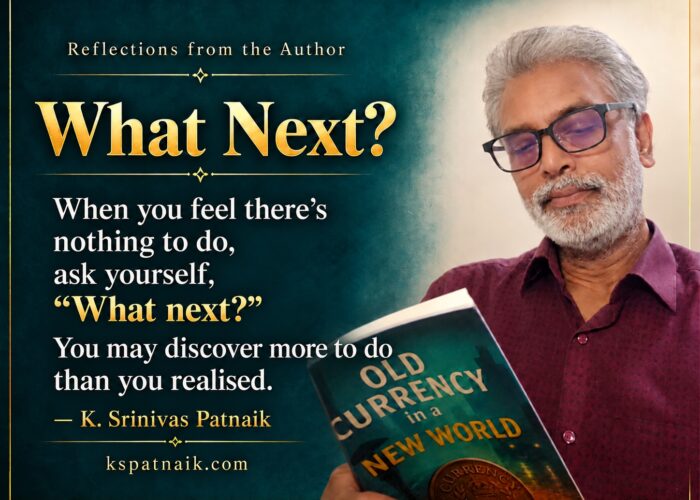
“When you feel there’s nothing to do, ask yourself, ‘What next?’ You may discover more to do than you realised.”
Sometimes there is something available that we have simply stopped noticing: an unfinished task, an interest waiting to be explored, a conversation to have or something we could learn. Asking the question can bring such possibilities into view.
Then there are the more difficult moments:
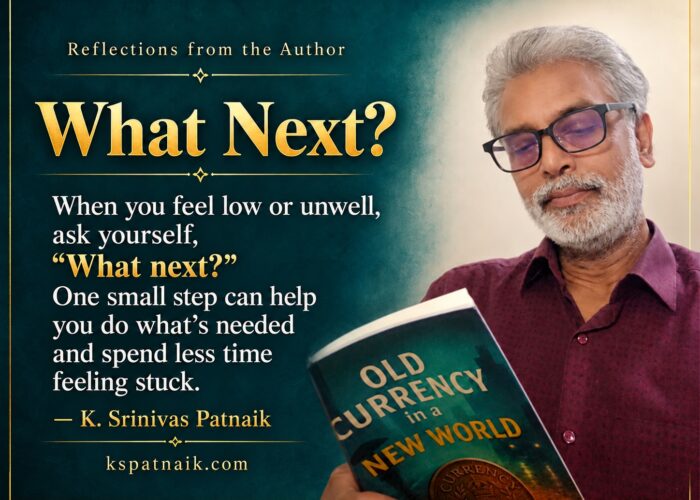
“When you feel low or unwell, ask yourself, ‘What next?’ One small step can help you do what’s needed and spend less time feeling stuck.”
In those moments, the next action needs to be manageable and appropriate. It could be a small task, a needed rest or reaching out to someone. We can respond to what the moment requires without mentally carrying everything that remains unfinished.
As the practice develops, something less predictable may also appear:
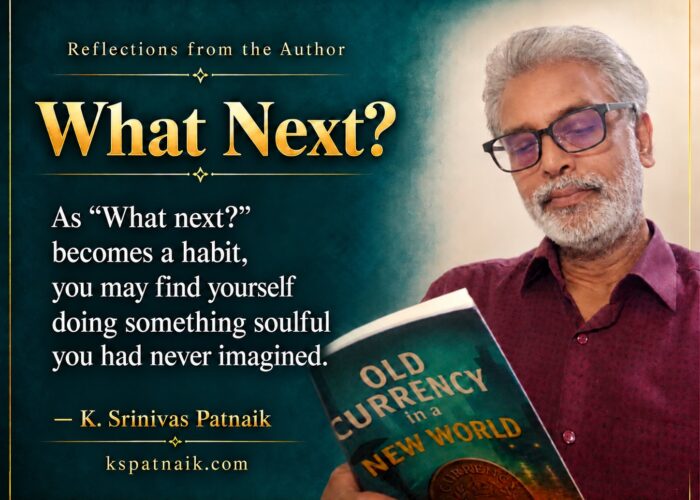
“As ‘What next?’ becomes a habit, you may find yourself doing something soulful you had never imagined.”
Even with a clear to-do list, something outside it may call for our attention. An unexpected interest or a quiet urge can become a meaningful experience when we act on it.
In an earlier reflection, I wondered whether such a small deviation might carry karma’s imprint. “Your inner design beckons.” Those words express the meaning I see in such moments: something personally significant invites our attention before we have fully understood it.
We can recognise that prompt, give it conscious attention, act on it appropriately and then continue with what needs doing. The experience itself may reveal why it mattered.
The seventh reflection returns to what regular practice can develop:
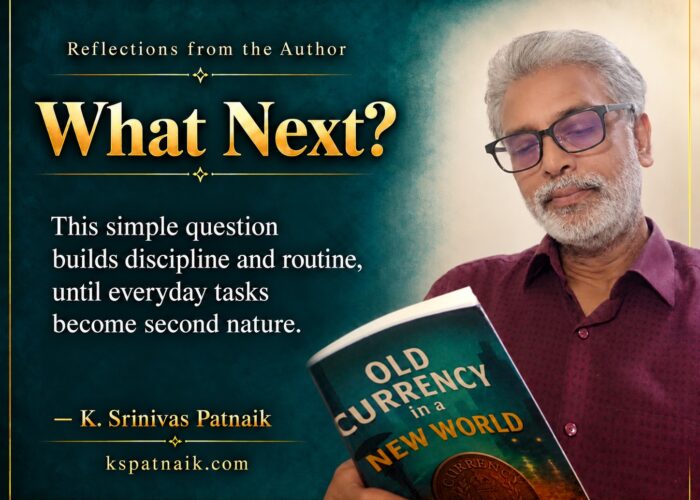
“This simple question builds discipline and routine, until everyday tasks become second nature.”
Initially, we practise remembering to ask the question. Gradually, asking and following through can become part of our everyday rhythm. Familiar activities acquire an ease that comes through repetition.
“Second nature” describes that growing familiarity. The practice becomes part of how we move through the day.
These seven reflections have also led me to look more closely at how experience, thought and action relate.
Our respective and respected minds are shaped by different experiences. Even where our assumptions appear similar, the experiences behind them may be quite different.
I often think of our daily experiences as experiments. We do something, encounter a result and learn from what happens. Some experiments succeed; some fail. Each gives us something further to work with.
When I speak here of action, I mean consciously chosen bodily activities: typing a message, fetching water, boarding transport or attending a meeting. Reflexes and automatic bodily functions fall outside what I am discussing.
A thought or decision can lead towards an action. The body carries out the chosen activity. Thinking about sending a message and actually typing and sending it are different stages.
The context from which we choose an action comes from the mind: what we understand, expect, remember and consider possible. Our experience influences that context, and further action gives us new experience.
I find it useful to picture experience as information, or data, and the mind as the processor working with it. This is the language through which I explore how what we have lived can influence what we imagine and what we choose to do.
When I describe thoughts “travelling,” I mean something familiar. I can be sitting in Singapore and mentally walking through my garden in India, drawing on the visual memories of my last visit. My body is here while, in thought, I move through a remembered place.
Education, knowledge, conversations and further experiences continually add to the material available to us. They widen the playing field for our thoughts.
A possibility may emerge from that material. We choose to explore it, the body carries out an activity, and the resulting experience gives us something new to understand. The cycle continues.
Yet sometimes we interrupt that movement by attaching a condition to an otherwise available action.
“In Order To” creates an invisible link between two independent actions, resulting in a tug of war. You want to do something, “BUT” you need to do something else before that. Doesn’t that sound familiar? Yes, it does. On every such occasion, I have asked the person: “What have these two things got to do with each other? Aren’t they completely independent?”
The link I am questioning is the one we impose where no practical dependency exists.
Where one action genuinely requires another, give that requirement its place in the sequence. Completing the prerequisite may itself be the answer to “What Next?”
For example, if I am waiting for a reply about one matter, I can still complete an independent task. If the reply is essential to a particular activity, I can identify what information is missing, ask for it and attend to another available action while waiting.
The pending matter has its place. It need not occupy every moment in between.
“What Next?” actually defuses that “BUT” by maintaining a constant focus on what needs to be done at that moment. Those actions are not linked; they are simply actions that need to be done at that moment. Executed, done and dusted… move on!
The question brings attention back to what is available now. We can choose an action, carry it out, observe the result and learn from the experience.
Over time, this can develop into a rhythm: clearer priorities, familiar routines and greater openness to something meaningful we had not anticipated.
Try it for a few weeks. Write down what needs doing. As one task draws to a close, ask the question. When you feel stuck, look for a manageable step. When an unexpected possibility appears, give it conscious consideration.
Notice what gets completed, what you learn and what becomes clearer through doing.
As this reflection draws to a close, ask yourself:
“What Next?”