Tag: Clarity Before Commitment

  • A Community Recognition in Sistakaranam Lekha

    A Community Recognition in Sistakaranam Lekha

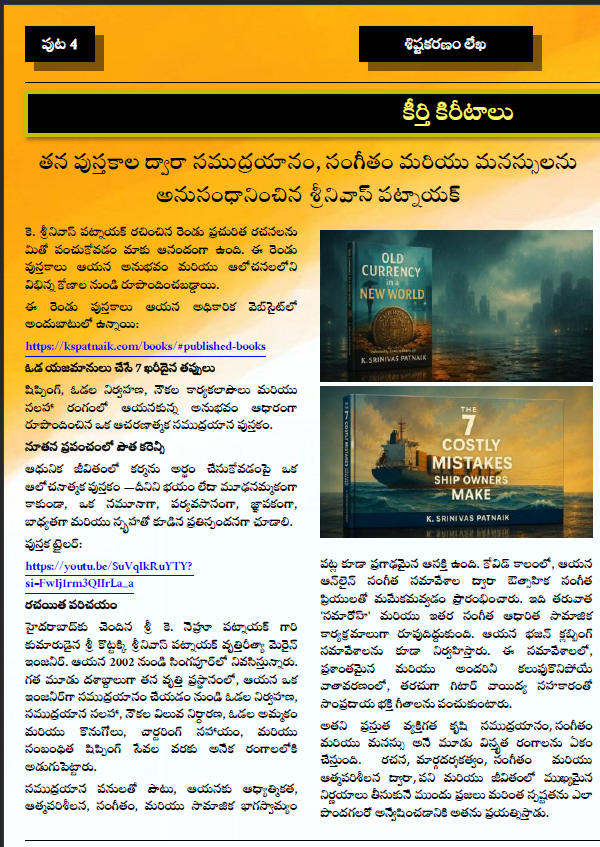
    It was a meaningful moment to see my two published books featured in the July 2026 issue of Sistakaranam Lekha, under the section Keerthi Kireetalu.

    The article shared details of both books:

    Old Currency in a New World: Understanding Karma in Modern Life

    and

    The 7 Costly Mistakes Ship Owners Make

    For me, this recognition is special because it comes from within the community.

    Sistakaranam Lekha is part of the wider work of Sistakaranam Ikyavedika, a digital community platform that documents and shares community updates, achievements, service initiatives, cultural contributions, newsletters, reports, and related activities.

    To have my books mentioned in that space feels both humbling and encouraging.

    Two Books, Two Dimensions

    These two books come from different parts of my life.

    The 7 Costly Mistakes Ship Owners Make comes from my maritime journey — from sailing as a marine engineer to ship management, ship valuation, advisory, sale and purchase, chartering support, and commercial decision-making.

    It is a practical book written for ship owners, buyers, financiers, brokers, and maritime professionals who wish to avoid costly mistakes before making important commitments.

    Old Currency in a New World comes from another dimension of life — reflection, observation, meditation, personal experience, difficulty, responsibility, and the understanding of Karma in modern life.

    It explores Karma not as fear, punishment, or superstition, but as pattern, consequence, memory, responsibility, and conscious response.

    One book comes from Maritime.

    The other comes from Mind.

    Together, they reflect two important sides of my journey.

    The Article in Lekha

    The Lekha article introduced the books and also briefly referred to my journey as a marine engineer, my years in Singapore, my work in shipping, and my continuing interests in spirituality, self-reflection, music, and community participation.

    It also mentioned the way my present personal direction brings together three broad areas:

    Maritime, Music, and Mind

    This phrase has become increasingly meaningful to me.

    Maritime gives me commercial grounding and professional experience.

    Music gives me connection, healing, and community.

    Mind gives me the space for reflection, clarity, writing, and conscious response.

    English Summary of the Lekha Feature

    The July 2026 issue of Sistakaranam Lekha featured two published books by K. Srinivas Patnaik.

    The article mentions that both books are available through the author’s official website:

    Published Books

    The 7 Costly Mistakes Ship Owners Make

    A practical maritime book based on the author’s experience in shipping, ship management, vessel operations, and maritime advisory work.

    Old Currency in a New World

    A reflective book on understanding Karma in modern life — not as fear or superstition, but as pattern, consequence, memory, responsibility, and conscious response.

    The article also includes the book trailer link and introduces the author as a professional marine engineer who has been living in Singapore since 2002.

    It refers to his journey across shipping, ship management, maritime advisory, ship valuation, sale and purchase, chartering support, and related shipping services.

    Alongside his maritime work, the article notes his interest in spirituality, self-reflection, music, and community participation. It also mentions his involvement in online music sessions during the Covid period, which later developed into Samaroh and other music-based community gatherings, including Bhajan Clubbing.

    The article observes that his present direction brings together three broad areas:

    Maritime, Music, and Mind

    Through writing, mentoring, music, and self-reflection, he seeks to explore how people can gain greater clarity before making important decisions in work and life.

    Gratitude to the Community

    I am sincerely grateful to the Lekha team for carrying this article and for including my work among the community’s achievements.

    I also thank the wider Sistakaranam community, Sistakaranam Ikyavedika, and the people associated with AISKA and related community initiatives for continuing to document, preserve, and share the journeys of individuals across different fields.

    Community recognition is not only about visibility.

    It reminds us that our work belongs to a larger stream of memory, identity, and contribution.

    The Journey Ahead

    Both books are now available through my official website, with links to Kindle, paperback, Amazon, Notion Press, and book trailers.

    Book details and purchase links:

    Published Books

    The full July 2026 issue of Sistakaranam Lekha can also be accessed here:

    July 2026 issue of Sistakaranam Lekha

    I hope these books reach the readers they are meant to reach.

    One is for better maritime decisions.

    The other is for deeper reflection on life’s patterns.

    Grateful for the encouragement.

    — K. Srinivas Patnaik

  • When Not Doing a Deal Is the Right Decision

    In shipping, there is often a natural excitement around a deal.

    A vessel becomes available.
    A buyer shows interest.
    A broker says there is movement.
    A number is mentioned.
    A window appears to open.

    At that moment, momentum can feel like opportunity.

    But not every opportunity deserves pursuit.

    Some opportunities deserve review.
    Some deserve patience.
    Some deserve more questions.
    And some deserve to be left alone.

    The Discipline to Pause

    One of the hardest things in maritime business is not always finding a deal. Sometimes, the harder thing is knowing when not to continue.

    This is especially true when time, emotion, competition, or incomplete information begins to influence decision-making.

    A vessel may look attractive on paper.
    A price may appear sensible at first glance.
    A market story may sound convincing.
    A counterparty may appear confident.

    But shipping decisions are rarely carried by one factor alone.

    A vessel is not only a price.
    It is condition, class, trading history, employment possibility, regulatory exposure, upcoming capital expenditure, documentation, authority chain, financing comfort, inspection reality, and commercial timing.

    When these layers are not clear, proceeding too quickly can convert excitement into exposure.

    The Hidden Cost of a Poorly Reviewed Deal

    A weak deal does not always reveal itself immediately.

    Sometimes the cost appears later.

    It may appear during inspection.
    It may appear during class review.
    It may appear during drydocking.
    It may appear when the vessel cannot be employed as expected.
    It may appear when documentation does not support the assumptions made earlier.
    It may appear when brokerage, authority, or mandate issues surface after momentum has already been created.

    By then, the buyer, seller, broker, or advisor may already be emotionally invested.

    That is why the early stage matters so much.

    The earlier a decision is reviewed, the easier it is to remain objective.

    Not Doing a Deal Is Also a Decision

    In maritime business, walking away is sometimes seen as a loss.

    I do not see it that way.

    Walking away from an unclear, unsupported, or badly structured deal can be a very strong commercial decision.

    It may protect capital.
    It may protect reputation.
    It may protect relationships.
    It may protect future optionality.
    It may prevent disputes that would have been avoidable with better review.

    Not doing a deal is not weakness.

    Sometimes, it is discipline.

    The Role of Independent Review

    Independent review is valuable because it slows the emotional pace of a transaction.

    It asks questions such as:

    • Is the commercial basis clear?
    • Is the vessel suitable for the intended purpose?
    • Are the valuation assumptions realistic?
    • Is the authority chain properly understood?
    • Are the technical risks visible?
    • Are upcoming costs being underestimated?
    • Is the deal being driven by evidence or excitement?
    • Is there enough clarity to proceed responsibly?

    These questions may not always stop a deal.

    Sometimes, they strengthen it.

    A well-reviewed deal becomes easier to defend, finance, negotiate, and execute. But a poorly reviewed deal often depends on optimism.

    Optimism has its place.

    But it should not replace judgement.

    Clarity Before Commitment

    This is why I keep returning to one simple principle:

    Clarity before commitment.

    Before a buyer commits, before a seller entertains unnecessary market noise, before a broker spends time pushing weak interest, and before a financier begins relying on incomplete assumptions, clarity must come first.

    Clarity does not mean certainty in every detail.

    Shipping will always carry uncertainty.

    But clarity means the main risks are visible, the assumptions are known, the authority chain is understood, the commercial case has been examined, and the decision is not being made blindly.

    The Quiet Strength of Saying No

    There is a quiet strength in saying:

    “Not yet.”
    “Not enough information.”
    “This does not fit.”
    “The risk is not justified.”
    “The chain is unclear.”
    “The timing is wrong.”
    “This should not be pursued.”

    These are not negative responses.

    They are responsible responses.

    A mature maritime decision is not measured only by the deals completed. It is also measured by the mistakes avoided.

    Final Reflection

    In shipping, many expensive outcomes begin long before the loss is visible.

    They begin in assumptions, shortcuts, unclear authority, weak review, poor documentation, emotional urgency, or misplaced confidence.

    That is why not doing a deal can sometimes be the right decision.

    Because the purpose of good judgement is not to chase every opportunity.

    It is to recognise which opportunities deserve commitment — and which ones deserve to be left behind.