Category: Music

  • Jam & Learn — An Example of Inspiration

    From the Archives

    This reflection was originally written on 26 March 2010 as a Facebook Note and was last edited on 6 May 2021. It has been lightly refined and republished here for clarity and readability, while preserving the original thought, feeling, gratitude, and intent.

    Jam & Learn is an extension of my hobby — playing the guitar for fun, not as a profession.

    As most of you know, I am a full-time marine engineer, now managing ships from ashore. But throughout my sailing years, I carried my guitar with me on every ship I sailed on.

    My First Ship

    I was in Kolkata — Calcutta then — staying at Port View Guest House. I am amazed that I could remember that name within a few seconds.

    My batchmate Pandey was also there, waiting to join his ship, and was staying in the same guest house.

    He was the one who inspired me to carry the guitar on my first ship.

    I was very apprehensive. I thought my superiors may not like it, and I might probably get a good ragging for carrying a guitar on board.

    But Pandey advised me to carry it quietly.

    “Take it into your room,” he said, “and don’t mention it outside for at least six months. After that, it will be fine.”

    So I covered the guitar in a plastic bag and cloth, carried it straight to my cabin, and kept it with me.

    Of course, my father was the one who had carried the guitar all the way from Nagpur. He was posted there at the time I was joining my first ship. He brought it to Kolkata when he came to see me off.

    I was joining my first SCI ship at Chennai.

    Ever Since

    Ever since then, I have carried my guitar on all ships.

    It is not that I played every day, but I loved having it with me.

    There were moments at sea when you would suddenly yearn to play a few notes of a wonderful song. And if the guitar was not there at that moment, it felt deeply disappointing.

    On average, I probably strummed or played at least once a week.

    Of course, once my shipmates came to know about the guitar, they would carry it all the way to parties, and we would jam on Hindi melodies of every kind.

    There are so many wonderful compositions by our esteemed music directors. Some songs simply refuse to leave you.

    I will write more about the associations and inspirations that kept me going until I finally met my only Guru, Shri Radha Vijayan of Mirra Fine Arts, Singapore.

    Please do visit the music school’s website and see how he has created a world of music single-handedly, with soulful dedication to the guitar.

    He is a wonderful human being and can inspire you even through his quiet and unassuming presence.

    I have known him for more than four years, and I could write lengthy essays on each meeting we have had.

    Jam & Learn is a practical example of how far inspiration can take you.

    It is still just the beginning.

    Thank you, Sir, for being there.
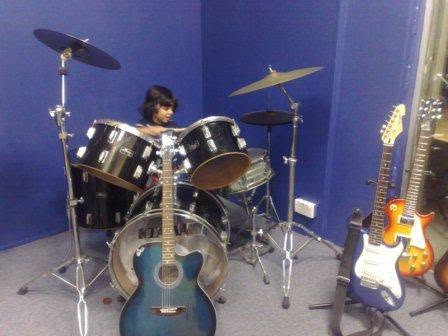
    [Insert photograph here]

    Caption suggestion:
    Little drummer in “Papa’s studio.”

    The little drummer, Vahein, jumps whenever he hears that we are going to “Papa’s studio.” That is what he calls it.

    I have attached his picture with this note.

    More in my next.

    Until then, please hear the music even in silence.

    Try it.

    You can.

    Have fun.

    Cheers,
    Srinivas
  • Before My Glass of Coke Became Empty

    From the Archives

    This reflection was originally published on 3 April 2010 as a Facebook Note and was last edited on 6 May 2021. It has been lightly refined and republished here for clarity and readability, while preserving the original thought, feeling, humour, and intent.

    It was during the final year of DMET, when I had just started learning to play the guitar.

    I am not sure how I sounded in those days, but this bunch of batchmates made me feel like a professional musician. They treated me like a celebrity and made sure I was always taken care of.

    In fact, I used to get stuffed with Coke because someone in the group would somehow notice that Patti’s glass was getting empty.

    And before my glass of Coke became empty, it would get filled up again.

    Come on guys, I miss you all.

    Tutu, Balda, Vohra, Deepak, Shivi, Sunil, Pandey, Gohil, DK — they were my early and only audience. What a wonderful lot of admirers they were.

    They probably never heard what I was actually playing, because they were too busy getting intoxicated. I, on the other hand, was an excessive passive smoker in those days, staying around these guys while they smoked, laughed, sang, and enjoyed themselves.

    Somehow, I loved being with them.

    I kept playing whatever few notes or chords I knew.

    Tutu was a wonder kid when it came to tunes. He could pick up the right notes and immediately catch you if you went off track.

    I remember him playing bass with us in the band. He fretted it out, picked up the notes, and figured out the trick to play the prelude piece of Saagar Kinaare. I still play it almost the same way even today.

    Later, I struggled and picked up the prelude for Pal Pal Dil Ke Paas.

    I used to play for these guys till the early hours of the morning. For me, it was also a challenge to play in dim light without looking at the guitar’s fretboard.

    It had been only about six months since I had seriously started playing, and I was fascinated whenever I saw guitarists play without even looking at the instrument.

    The band group of my seniors was a treat to watch. Bernard was a genius. He is now in Miami with Aalborg, if I remember correctly.

    Those were the days when these guys would fill up my glass of Coke and request me to continue strumming notes for them.

    At times, they even used to bring along extra stock. I realised that only later.

    But I enjoyed every moment of playing the guitar for this amazing bunch of friends.

    Tutu used to ask me several times:

    “Abe, daaru peeta nahin, phir itna der bajata kaise hai?”

    I do not have the answer to this day.

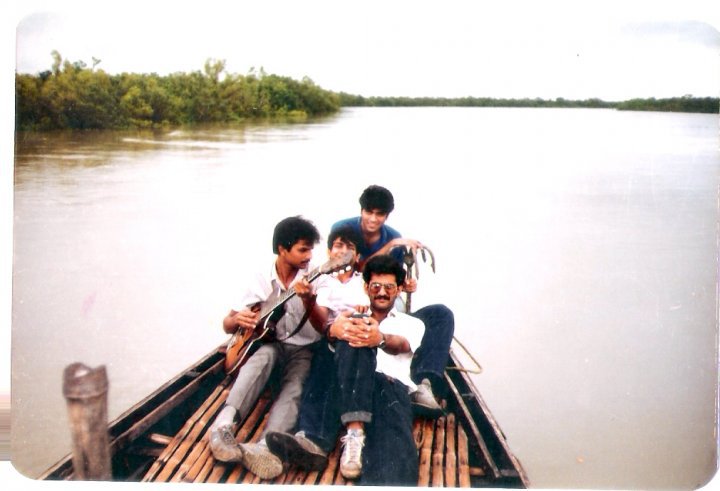
    Final year DMET memories from 1990 — on a boat in the Sunderbans Delta, with guitar, songs, and batchmates.

    In 2010, I had written that I wanted to make a new composition for the 1990 batch.

    The last one I had composed in memory of late P.D. — such a wonderful person he was — was called How I Wish You Were Here. The lyrics were written by Vohra.

    I composed it using a simple chord progression that I had learnt from Amit Dutta of Shiva fame.

    Some memories remain alive not because they were grand, but because they were shared with the right people.

    A guitar. A dimly lit room. A glass of Coke. A few friends. A few songs.

    And a feeling that still remains.

    Say cheese and keep smiling.

    Srinivas
    Patti, for all of them

  • Baby Elephant Walk — Bunking the CPT Workshop

    From the Archives

    This reflection was originally published on 10 April 2010 as a Facebook Note and was last edited on 14 March 2021. It has been lightly refined and republished here for clarity and readability, while preserving the original thought, feeling, humour, and intent.

    We used to attend workshops as part of our training at DMET. This happened during the second and third years of our training period.

    Each cadet was assigned to a shore workshop. In Kolkata, some of us were assigned to places like CPT, GRSE, and others. I do not remember much about the other workshops, but since I was assigned to CPT, a few memories still remain.

    This was probably sometime in the middle of 1989, when I was in the third year.

    I cannot recollect all the facts clearly, but somehow one day it was me, Tutu, and Balda at my place. Of course, we used to land up there when Dad was at office. Otherwise, I would have had to do a bit of explaining.

    Mom was cool about it. She was happy to have her son around — almost a “to hell with whatever he is doing” kind of affection. She knew most of the bunch from the first year itself, when friends like Sharat would come home on Sundays and crash on the swimming chairs lying around the house.

    It was one of those days when there was a guitar at home, thanks to my sister. That is another story for another day.

    Tutu knew how to pluck some notes, and so did Balda. In fact, Balda had my guitar with him for some time — the maroon one. He had made it look quite jazzy by pasting stickers all over it.

    I remember he used to play the tune of Neele Neele Ambar Par very nicely.

    My early inspiration towards the guitar was generated by these two friends.

    One day, we were sitting at my house, and Tutu and Balda were struggling with the notes of Baby Elephant Walk.

    What a wonderful tune it is. I cherish it to this day.

    I am sure many of us have heard it several times, especially if we have ever visited a circus. It is the kind of tune that would be played by the circus band when the elephants walked in.

    I watched them trying to play the notes, moving across the top three strings of the guitar.

    Both of them taught me the notes.

    Somewhere inside, I made a quiet vow to myself: one day, I would surprise them by playing the tune in the dark during load-shedding at the hostel.

    So I practised.

    I practised with closed eyes. I hurt my fingers. I struggled. But I persisted.

    Finally, I managed to get the tune flowing through my fingers.

    Even while refurbishing this note, I paused for a moment and played the tune again. Yes — the same practised flow still works.

    It is amazing how some things we learn in our younger years get imprinted so deeply into our system.

    When I had first started learning it, I was somehow very sure that I would be able to play the tune. I do not know why I had that confidence. Looking back now, I feel that perhaps the positive thought itself was the reason I could play what felt like a difficult tune at that stage — especially when I had only touched the guitar a few times in my life.

    Positive thoughts reinforce an energy inside us. It may be invisible, but it can make us attempt things that otherwise seem impossible.

    If you want to learn to play the guitar — or any other instrument — just buy one and explore.

    I am having my share of fun.

    I sincerely hope you do too.

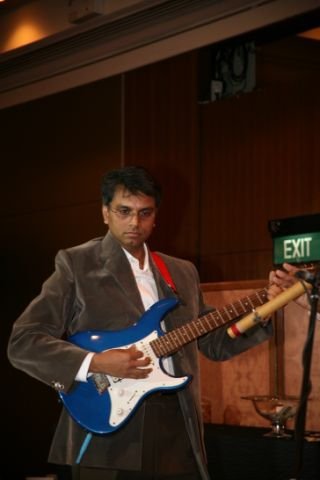
    With my first electric guitar, gifted by Sandhya, performing at a company annual dinner.

    Cheers,
    Patti
    Srini, for some

  • My Childhood Association with Music

    From the Archives

    Originally written on or around 19 April 2010 as a Facebook Note. Last edited on 14 March 2021. Lightly refined and republished here for clarity and readability, while preserving the original thought, feeling, and intent.

    My early association with music probably began with the Sri Lanka Broadcasting Corporation.

    There was a programme called Aap Hi Ke Geet, which used to be aired at 8 a.m. Before that, from around 7:30 a.m., there would be old Hindi songs, often punctuated by the voice of K. L. Saigal singing Jab Dil Hi Toot Gaya.

    Rafi and Kishore — these names were probably called out more frequently in our home than our own names.

    My mother and my youngest aunt, Padmaja, often had friendly tussles over Kishore Kumar and Mohammed Rafi. My aunt was firmly on Kishore’s side, while my mother was devoted to Rafi. I grew up hearing these maestros in the background of their affectionate arguments.

    Binaca Geet Mala and Ameen Sayani were also part of the soundscape of those years. I suppose they belonged to the lives of many Indians of my generation — people who grew up with radio, lyrics, melody, and memory all woven together.

    There was also a dedicated student of my father, from around 1975 to 1977. His name was Ravana. He was a very good singer then, and I am sure he still is, although I have not met him for many years.

    Ravana Bhaiya was my singing idol.

    He used to sing all the Rafi and Kishore songs he knew while taking us to school on his bicycle — my sister Sunita and I sitting as pillion riders. It was almost a 30-minute ride, and music travelled with us.

    One characteristic of his remains crystal clear in my memory. Whenever he sang, he would hold his wrist in front of his mouth as though he were holding a microphone. I do not think I ever saw him sing with an actual microphone in his hand, but in his imagination, the microphone was always there.

    Another interesting thing about him was that he was ready to sing at the slightest prompt. And he sang really well.

    Ravana Bhaiya taught me the complete song Om Shanti Om from Karz, including the lyrics and tune.

    I was 11 years old during my aunt’s marriage in December 1980. One afternoon, all the relatives had gathered and were playing Antakshari. My cousin Surya Prakash started singing Om Shanti Om but forgot the lyrics midway.

    You should have seen the surprise on my father’s face when I sang the whole song correctly, with all the lyrics.

    That memory has stayed with me.

    My association with rhythm was also very strong from childhood.

    I used to beat the wooden bed, the wooden almirah, and probably many more surfaces that only my mother would remember properly. I was always finding places to practise my percussion skills.

    My grandfather had those wide, low-height wooden stools — in Telugu, we call them peta — on which he used to sit and have his meals. Those stools were my favourite drums because of the bass sound they produced when I beat them.

    Much later, I was amused to see that the Spanish had converted a similar idea into something called a drum box or cajón.

    I also remember my cousin sister Vandana, whom I call Chinnakka, during one of our vacations in the village. I must have been around eight or nine years old. She was watching my fingers very intently as I played beats on the stool while others were singing.

    She could not understand how the different sounds and taps were being created. Finally, she asked me to show her slowly.

    I did.

    I am still not sure whether she understood anything.

    Even today, when I am sitting and jamming at parties and cannot immediately pick the chords, I instinctively turn the guitar around and use the back of it to play the beats.

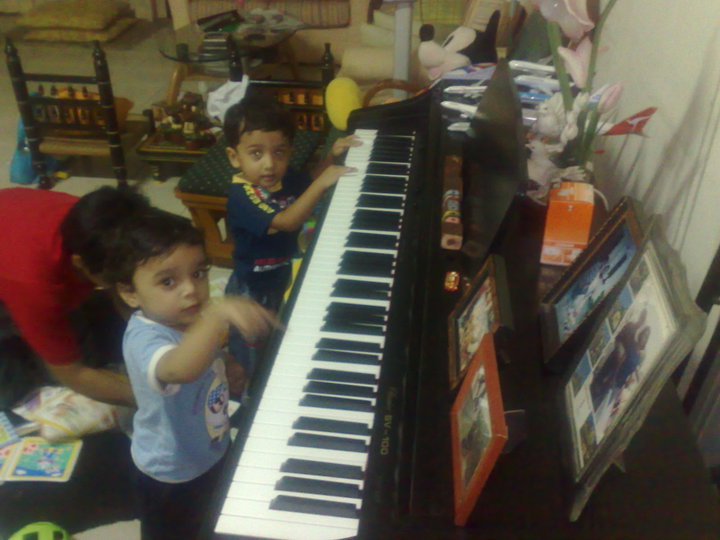
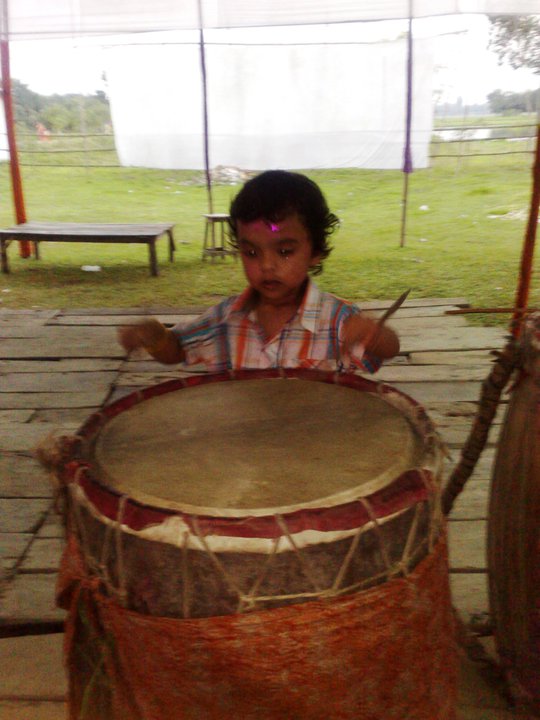
    The beginning of association for Vahein and Revan.

    Vahein playing the Dhak during the Dussehra festival in 2008.

    Our childhood associations live with us throughout our lives. They quietly reflect in our day-to-day activities, our instincts, and our passions.

    Sometimes, what begins as a sound in the background becomes a rhythm we carry for life.

    Let us follow those instincts and evoke the blissful moments that still make us feel amazingly good.

    Cheers,
    Srinivas
    Shonu, for many of the memories above

  • Tribute to Munna — The Simple Guitarist

    From the Archives

    This reflection was originally shared as a Facebook Note on/around 19 May 2010, and was last edited on 6 May 2021. It has been lightly refined and republished here for clarity and readability, while preserving the original thought, feeling, and intent.

    It was in 1989, when we returned from Mumbai after spending a year there for our second year of DMET — Marine Engineering training.

    While I was in Mumbai, I had heard that my sister had bought a guitar. Only she could have managed such a feat at home. Daddy was the kind of person who would not always say it directly, but you knew what he wanted: “Focus on your studies.”

    We were staying at BNR in Kolkata — Calcutta in those days — and my sister had engaged a guitar tutor. He later became my guitar idol during that period of my life.

    His name was Munna.

    Munna was my first guitar tutor, and in many ways, he opened the door through which music entered my life more seriously.

    He was a building construction labourer by profession, but he could play the guitar with amazing ease. He used to play for an orchestra and seemed to know the latest interludes, opening notes, and chords of almost any Hindi song I could name.

    I knew he could not even afford to buy himself a good guitar in those days. Yet the way he played, the way he understood film music, and the way he made the guitar speak, left a deep impression on me.

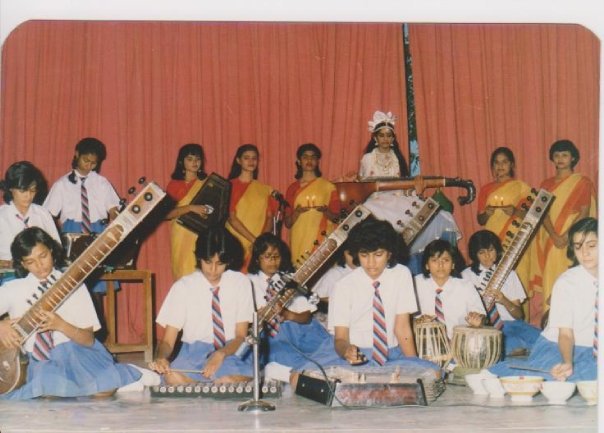
    Sandhya playing the Jal Tarang — a family archive photograph from school days, retained here as part of the original memory.

    I do not know where Munna is today, but my sincere wishes go out to that wonderful guitarist and very good human being.

    He taught me the basics of Hindi music chords, and even today I can attribute some of the interlude pieces I play to his training. He never charged me a single rupee as a fee. I still feel a strong urge to look for him whenever I think of visiting Kolkata.

    I can still remember him sitting inside the corner of a small shop operated by his elder brother. If I remember correctly, his brother used to sell tobacco and other general items. Munna would sit there and play his orchestra electric guitar, producing clean notes even without a speaker.

    There was something special about our relationship.

    Looking back, I realise that much of my motivation to play the guitar in those days came from this wonderful person. I used to look forward to returning from DMET on weekends just to spend an hour with him.

    Fortunately, he always made time for me. Whenever I called him, he would come.

    May God bless him.

    Some people touch our lives quietly and become part of our memories forever.

    I am sure you too can think of a few such people in your own life — and smile.