Category: Life Reflections

  • Run the Right Race, Not the Rat Race

    Run the Right Race, Not the Rat Race

    A 1-minute reflection

    Every athlete who enters a race carries the desire to win.

    They may eventually receive gold, silver, bronze — or nothing at all. But no serious participant begins by saying, “I am not here to win.”

    Beyond the prize, recognition, and reward, there is something deeper.

    The inexplicable joy of knowing:

    “I gave myself fully to this.”

    Life is somewhat like that.

    Events keep coming. Races begin and end. Sometimes we win. Sometimes we lose. Sometimes we fall. Sometimes we have to start again.

    But one question remains:

    What is the gold medal we are all running after?

    Honestly, I do not fully know.

    Maybe nobody can define it for another person.

    But there is one quiet clue — the unexplained satisfaction we feel when we are doing something that feels aligned with who we are.

    That inner satisfaction is a guide.

    The problem is, many of us stop listening to it.

    The world pulls us away. Peers distract us. Society pushes us towards comparison, status, packages, and external validation.

    Even young people today often choose their subjects, careers, and futures based mainly on what “package” they may get — not necessarily on what they are naturally designed for.

    But can a sprinter win gold if he or she is unsure, distracted, or running someone else’s race?

    No.

    Each person has their own race to run.

    The purpose of life is not written in one common book.

    It is your journey.

    Your destination.

    Your decision.

    Human instinct is built to race.

    But wisdom lies in this:

    Run the right race.

    Not the rat race.

    Are you running your race, or someone else’s?

  • The Air, the Soul, and the Purpose of Birth

    The Air, the Soul, and the Purpose of Birth

    A 3-minute reflection

    The air around us does not understand the difference between stench and scent.

    It carries both without judgement, without preference, and without knowing what it is carrying.

    But when that air is breathed in by a person, the person immediately recognises whether it carries a bad smell or a beautiful fragrance.

    The air remains detached.

    It only carries.

    In the same way, the soul may carry impressions, tendencies, and subtle ingredients gathered through its journey. It may not judge them as good or bad. It simply carries them.

    But when that soul enters a new body, the individual begins to experience those tendencies through behaviour, likes, dislikes, fears, attractions, reactions, and repeated patterns.

    Some tendencies are easy to understand.

    Some are very difficult to explain.

    For example, my younger son has always had an unusual discomfort with stickers of any kind.

    Once, I had borrowed a friend’s car for a day. When I was dropping my son to school, he refused to sit in the front seat. When I asked him why, he simply pointed to the stickers on the dashboard.

    He is now sixteen years old, and this tendency has been there from his baby days.

    Where does such a tendency come from?

    It is difficult to say.

    But it makes me reflect deeply on how certain impressions may travel with the soul, even before the individual fully understands them.

    The tendencies carried by the soul may remain with a person throughout life. But they are not necessarily permanent in their existing form.

    With sincere effort, they can be observed, refined, converted, and elevated.

    That effort is Sadhana.

    To understand ourselves, we need Swadhyay — self-study.

    To practise what we learn, we need Seva — service.

    And to remain steady in this path, we need Satsang — the company of those who are also walking in the same direction.

    In the modern world, identifying our tendencies has become difficult.

    There is too much distraction, too much noise, and very little space for inner observation.

    But perhaps this is one of the deeper purposes of life.

    The purpose of this birth may not be only to achieve, possess, or succeed externally.

    Perhaps it is also to refine what the soul carries.

    If we carry tendencies that are destructive — hatred, anger, jealousy, cruelty, short temper, or anything that causes pain to ourselves or others — we must make sincere efforts to recognise them and gradually release them.

    If we carry tendencies that are constructive — love, patience, kindness, discipline, compassion, courage, and peace — we must strengthen them, enhance them, and offer them back to existence in a better form.

    So perhaps the purpose of this birth is simple, yet profound.

    To reduce the stench.

    To enhance the fragrance.

    And when the time comes to leave this body, to release a better-quality soul back into the vast space from where it came.

    What fragrance are we cultivating within ourselves?

  • The Body Speaks Early. We Often Listen Late.

    A calm person sitting near a window with tea and a notebook, reflecting on early body signals and wellness awareness.
    The body often speaks before we are ready to listen.

    This happens more often than we realise.

    When discomfort appears, we usually rush to deal with the symptom.

    Pain.
    Fever.
    Running nose.
    Itching.
    Swelling.
    Tiredness.
    Stiffness.
    Poor sleep.
    Low energy.

    These are the things we feel.

    But very often, these are not the beginning of the problem. They are the visible or felt outcome of something that may already be happening inside the body.

    Over the years, most of us have been trained to first reduce discomfort. If there is pain, we want the pain to stop. If there is fever, we want the fever to come down. If there is itching, we want the itching to disappear.

    There is nothing wrong with seeking relief.

    There is also nothing wrong with going to a doctor. In fact, when symptoms are serious, persistent, unusual, or frightening, proper medical advice is important.

    But along with treating the discomfort, I feel we should also pause and ask a deeper question:

    What could have triggered this?

    Many times, we do not even ask that question.

    We simply say, “I am not feeling well,” and then immediately look for something to make the feeling go away.

    But are we truly unwell in the way the mind imagines?

    Sometimes the mind creates its own explanation based on past experience. A pain in one place may remind us of an old problem. A skin irritation may trigger fear. A sudden discomfort may make us assume the worst.

    But the same symptom can come from different causes.

    A headache may not always mean the same thing.
    Body pain may not always mean the same thing.
    Skin irritation may not always mean the same thing.
    Tiredness may not always mean the same thing.

    Something may be happening inside the body that we cannot see.

    And because we cannot see it, we often start assuming.

    That is where confusion begins.

    What I am slowly learning is this:

    Before we panic, and even while we seek proper medical guidance where needed, we should also observe our own recent life.

    What happened in the last few days?

    Did we sleep badly?
    Did we skip meals?
    Did we eat too much?
    Did we eat something unusual?
    Were we under pressure?
    Did we drink enough water?
    Were we sitting too long?
    Did we stop walking or moving?
    Were we emotionally disturbed?
    Did we ignore rest?
    Did we push the body beyond its usual rhythm?

    Sometimes the body is not attacking us.

    Sometimes it is only reporting what we have been doing to it.

    This does not mean we should self-diagnose carelessly.

    It simply means we should become more aware.

    There is a difference between panic and awareness.

    Panic says:
    “Something is wrong. I must react immediately.”

    Awareness says:
    “Something is being shown. Let me observe carefully.”

    The body has its own language.

    It speaks through energy, sleep, appetite, digestion, skin, pain, mood, stiffness, recovery, and many small signals that we often dismiss.

    In my own journey, I learnt that the body does not usually become serious in one day.

    It whispers first.

    Then it repeats.

    Then it raises its voice.

    And when we still do not listen, it may finally force us to stop.

    That is why I believe wellbeing begins much earlier than treatment.

    It begins with observation.

    It begins with tolerance.

    It begins with asking better questions.

    It begins with remembering what we did to the body before blaming the body for reacting.

    This page is not about fear.

    It is about listening earlier.

    Because the body often speaks early.

    We simply listen late.

    This reflection is part of my wider journey through wellness, awareness, and daily discipline.

    The body often speaks early.

    We simply listen late.

    Wellbeing begins with awareness.

  • Jam & Learn — An Example of Inspiration

    From the Archives

    This reflection was originally written on 26 March 2010 as a Facebook Note and was last edited on 6 May 2021. It has been lightly refined and republished here for clarity and readability, while preserving the original thought, feeling, gratitude, and intent.

    Jam & Learn is an extension of my hobby — playing the guitar for fun, not as a profession.

    As most of you know, I am a full-time marine engineer, now managing ships from ashore. But throughout my sailing years, I carried my guitar with me on every ship I sailed on.

    My First Ship

    I was in Kolkata — Calcutta then — staying at Port View Guest House. I am amazed that I could remember that name within a few seconds.

    My batchmate Pandey was also there, waiting to join his ship, and was staying in the same guest house.

    He was the one who inspired me to carry the guitar on my first ship.

    I was very apprehensive. I thought my superiors may not like it, and I might probably get a good ragging for carrying a guitar on board.

    But Pandey advised me to carry it quietly.

    “Take it into your room,” he said, “and don’t mention it outside for at least six months. After that, it will be fine.”

    So I covered the guitar in a plastic bag and cloth, carried it straight to my cabin, and kept it with me.

    Of course, my father was the one who had carried the guitar all the way from Nagpur. He was posted there at the time I was joining my first ship. He brought it to Kolkata when he came to see me off.

    I was joining my first SCI ship at Chennai.

    Ever Since

    Ever since then, I have carried my guitar on all ships.

    It is not that I played every day, but I loved having it with me.

    There were moments at sea when you would suddenly yearn to play a few notes of a wonderful song. And if the guitar was not there at that moment, it felt deeply disappointing.

    On average, I probably strummed or played at least once a week.

    Of course, once my shipmates came to know about the guitar, they would carry it all the way to parties, and we would jam on Hindi melodies of every kind.

    There are so many wonderful compositions by our esteemed music directors. Some songs simply refuse to leave you.

    I will write more about the associations and inspirations that kept me going until I finally met my only Guru, Shri Radha Vijayan of Mirra Fine Arts, Singapore.

    Please do visit the music school’s website and see how he has created a world of music single-handedly, with soulful dedication to the guitar.

    He is a wonderful human being and can inspire you even through his quiet and unassuming presence.

    I have known him for more than four years, and I could write lengthy essays on each meeting we have had.

    Jam & Learn is a practical example of how far inspiration can take you.

    It is still just the beginning.

    Thank you, Sir, for being there.

    [Insert photograph here]

    Caption suggestion:
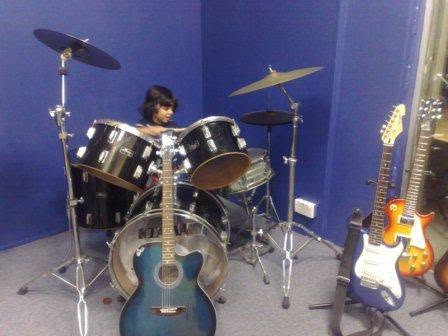
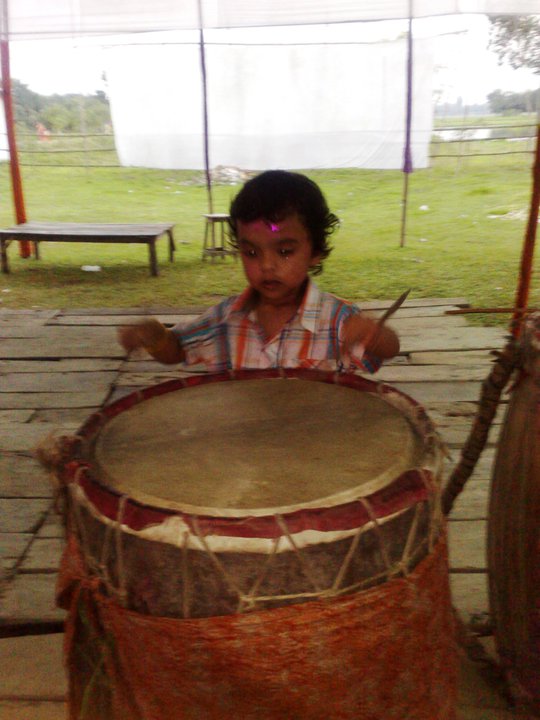
    Little drummer in “Papa’s studio.”

    The little drummer, Vahein, jumps whenever he hears that we are going to “Papa’s studio.” That is what he calls it.

    I have attached his picture with this note.

    More in my next.

    Until then, please hear the music even in silence.

    Try it.

    You can.

    Have fun.

    Cheers,
    Srinivas

  • Before My Glass of Coke Became Empty

    From the Archives

    This reflection was originally published on 3 April 2010 as a Facebook Note and was last edited on 6 May 2021. It has been lightly refined and republished here for clarity and readability, while preserving the original thought, feeling, humour, and intent.

    It was during the final year of DMET, when I had just started learning to play the guitar.

    I am not sure how I sounded in those days, but this bunch of batchmates made me feel like a professional musician. They treated me like a celebrity and made sure I was always taken care of.

    In fact, I used to get stuffed with Coke because someone in the group would somehow notice that Patti’s glass was getting empty.

    And before my glass of Coke became empty, it would get filled up again.

    Come on guys, I miss you all.

    Tutu, Balda, Vohra, Deepak, Shivi, Sunil, Pandey, Gohil, DK — they were my early and only audience. What a wonderful lot of admirers they were.

    They probably never heard what I was actually playing, because they were too busy getting intoxicated. I, on the other hand, was an excessive passive smoker in those days, staying around these guys while they smoked, laughed, sang, and enjoyed themselves.

    Somehow, I loved being with them.

    I kept playing whatever few notes or chords I knew.

    Tutu was a wonder kid when it came to tunes. He could pick up the right notes and immediately catch you if you went off track.

    I remember him playing bass with us in the band. He fretted it out, picked up the notes, and figured out the trick to play the prelude piece of Saagar Kinaare. I still play it almost the same way even today.

    Later, I struggled and picked up the prelude for Pal Pal Dil Ke Paas.

    I used to play for these guys till the early hours of the morning. For me, it was also a challenge to play in dim light without looking at the guitar’s fretboard.

    It had been only about six months since I had seriously started playing, and I was fascinated whenever I saw guitarists play without even looking at the instrument.

    The band group of my seniors was a treat to watch. Bernard was a genius. He is now in Miami with Aalborg, if I remember correctly.

    Those were the days when these guys would fill up my glass of Coke and request me to continue strumming notes for them.

    At times, they even used to bring along extra stock. I realised that only later.

    But I enjoyed every moment of playing the guitar for this amazing bunch of friends.

    Tutu used to ask me several times:

    “Abe, daaru peeta nahin, phir itna der bajata kaise hai?”

    I do not have the answer to this day.

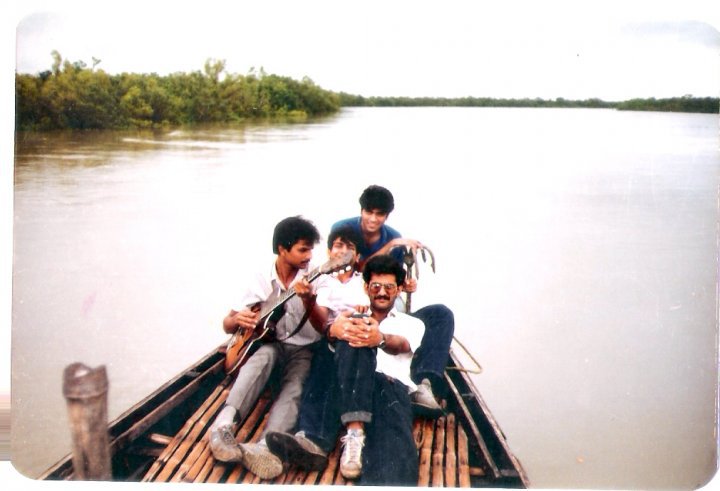
    Final year DMET memories from 1990 — on a boat in the Sunderbans Delta, with guitar, songs, and batchmates.

    In 2010, I had written that I wanted to make a new composition for the 1990 batch.

    The last one I had composed in memory of late P.D. — such a wonderful person he was — was called How I Wish You Were Here. The lyrics were written by Vohra.

    I composed it using a simple chord progression that I had learnt from Amit Dutta of Shiva fame.

    Some memories remain alive not because they were grand, but because they were shared with the right people.

    A guitar. A dimly lit room. A glass of Coke. A few friends. A few songs.

    And a feeling that still remains.

    Say cheese and keep smiling.

    Srinivas
    Patti, for all of them

  • Baby Elephant Walk — Bunking the CPT Workshop

    From the Archives

    This reflection was originally published on 10 April 2010 as a Facebook Note and was last edited on 14 March 2021. It has been lightly refined and republished here for clarity and readability, while preserving the original thought, feeling, humour, and intent.

    We used to attend workshops as part of our training at DMET. This happened during the second and third years of our training period.

    Each cadet was assigned to a shore workshop. In Kolkata, some of us were assigned to places like CPT, GRSE, and others. I do not remember much about the other workshops, but since I was assigned to CPT, a few memories still remain.

    This was probably sometime in the middle of 1989, when I was in the third year.

    I cannot recollect all the facts clearly, but somehow one day it was me, Tutu, and Balda at my place. Of course, we used to land up there when Dad was at office. Otherwise, I would have had to do a bit of explaining.

    Mom was cool about it. She was happy to have her son around — almost a “to hell with whatever he is doing” kind of affection. She knew most of the bunch from the first year itself, when friends like Sharat would come home on Sundays and crash on the swimming chairs lying around the house.

    It was one of those days when there was a guitar at home, thanks to my sister. That is another story for another day.

    Tutu knew how to pluck some notes, and so did Balda. In fact, Balda had my guitar with him for some time — the maroon one. He had made it look quite jazzy by pasting stickers all over it.

    I remember he used to play the tune of Neele Neele Ambar Par very nicely.

    My early inspiration towards the guitar was generated by these two friends.

    One day, we were sitting at my house, and Tutu and Balda were struggling with the notes of Baby Elephant Walk.

    What a wonderful tune it is. I cherish it to this day.

    I am sure many of us have heard it several times, especially if we have ever visited a circus. It is the kind of tune that would be played by the circus band when the elephants walked in.

    I watched them trying to play the notes, moving across the top three strings of the guitar.

    Both of them taught me the notes.

    Somewhere inside, I made a quiet vow to myself: one day, I would surprise them by playing the tune in the dark during load-shedding at the hostel.

    So I practised.

    I practised with closed eyes. I hurt my fingers. I struggled. But I persisted.

    Finally, I managed to get the tune flowing through my fingers.

    Even while refurbishing this note, I paused for a moment and played the tune again. Yes — the same practised flow still works.

    It is amazing how some things we learn in our younger years get imprinted so deeply into our system.

    When I had first started learning it, I was somehow very sure that I would be able to play the tune. I do not know why I had that confidence. Looking back now, I feel that perhaps the positive thought itself was the reason I could play what felt like a difficult tune at that stage — especially when I had only touched the guitar a few times in my life.

    Positive thoughts reinforce an energy inside us. It may be invisible, but it can make us attempt things that otherwise seem impossible.

    If you want to learn to play the guitar — or any other instrument — just buy one and explore.

    I am having my share of fun.

    I sincerely hope you do too.

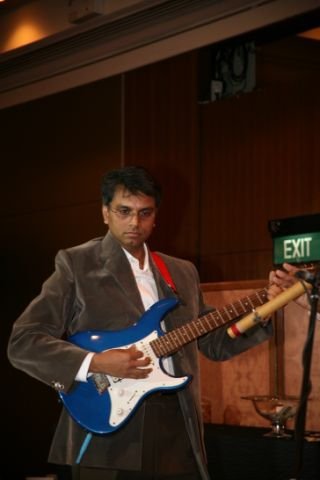
    With my first electric guitar, gifted by Sandhya, performing at a company annual dinner.

    Cheers,
    Patti
    Srini, for some

  • My Childhood Association with Music

    From the Archives

    Originally written on or around 19 April 2010 as a Facebook Note. Last edited on 14 March 2021. Lightly refined and republished here for clarity and readability, while preserving the original thought, feeling, and intent.

    My early association with music probably began with the Sri Lanka Broadcasting Corporation.

    There was a programme called Aap Hi Ke Geet, which used to be aired at 8 a.m. Before that, from around 7:30 a.m., there would be old Hindi songs, often punctuated by the voice of K. L. Saigal singing Jab Dil Hi Toot Gaya.

    Rafi and Kishore — these names were probably called out more frequently in our home than our own names.

    My mother and my youngest aunt, Padmaja, often had friendly tussles over Kishore Kumar and Mohammed Rafi. My aunt was firmly on Kishore’s side, while my mother was devoted to Rafi. I grew up hearing these maestros in the background of their affectionate arguments.

    Binaca Geet Mala and Ameen Sayani were also part of the soundscape of those years. I suppose they belonged to the lives of many Indians of my generation — people who grew up with radio, lyrics, melody, and memory all woven together.

    There was also a dedicated student of my father, from around 1975 to 1977. His name was Ravana. He was a very good singer then, and I am sure he still is, although I have not met him for many years.

    Ravana Bhaiya was my singing idol.

    He used to sing all the Rafi and Kishore songs he knew while taking us to school on his bicycle — my sister Sunita and I sitting as pillion riders. It was almost a 30-minute ride, and music travelled with us.

    One characteristic of his remains crystal clear in my memory. Whenever he sang, he would hold his wrist in front of his mouth as though he were holding a microphone. I do not think I ever saw him sing with an actual microphone in his hand, but in his imagination, the microphone was always there.

    Another interesting thing about him was that he was ready to sing at the slightest prompt. And he sang really well.

    Ravana Bhaiya taught me the complete song Om Shanti Om from Karz, including the lyrics and tune.

    I was 11 years old during my aunt’s marriage in December 1980. One afternoon, all the relatives had gathered and were playing Antakshari. My cousin Surya Prakash started singing Om Shanti Om but forgot the lyrics midway.

    You should have seen the surprise on my father’s face when I sang the whole song correctly, with all the lyrics.

    That memory has stayed with me.

    My association with rhythm was also very strong from childhood.

    I used to beat the wooden bed, the wooden almirah, and probably many more surfaces that only my mother would remember properly. I was always finding places to practise my percussion skills.

    My grandfather had those wide, low-height wooden stools — in Telugu, we call them peta — on which he used to sit and have his meals. Those stools were my favourite drums because of the bass sound they produced when I beat them.

    Much later, I was amused to see that the Spanish had converted a similar idea into something called a drum box or cajón.

    I also remember my cousin sister Vandana, whom I call Chinnakka, during one of our vacations in the village. I must have been around eight or nine years old. She was watching my fingers very intently as I played beats on the stool while others were singing.

    She could not understand how the different sounds and taps were being created. Finally, she asked me to show her slowly.

    I did.

    I am still not sure whether she understood anything.

    Even today, when I am sitting and jamming at parties and cannot immediately pick the chords, I instinctively turn the guitar around and use the back of it to play the beats.

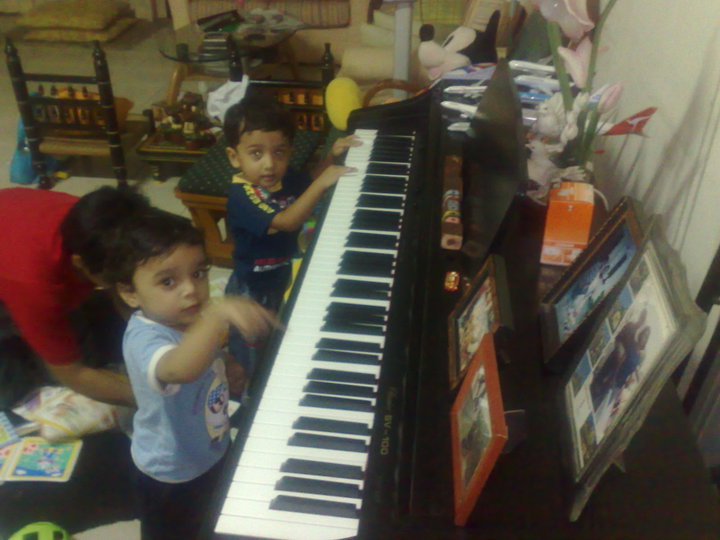
    The beginning of association for Vahein and Revan.

    Vahein playing the Dhak during the Dussehra festival in 2008.

    Our childhood associations live with us throughout our lives. They quietly reflect in our day-to-day activities, our instincts, and our passions.

    Sometimes, what begins as a sound in the background becomes a rhythm we carry for life.

    Let us follow those instincts and evoke the blissful moments that still make us feel amazingly good.

    Cheers,
    Srinivas
    Shonu, for many of the memories above

  • Binders: Beliefs and Solutions

    From the Archives

    Originally written on 13 February 2019 on my earlier blog “Just felt like it!”. Refined and republished on 27 April 2026 for clarity and readability, while preserving the original thought and intent.

    Binders: Beliefs and Solutions

    In the literal sense, binders are clips or fasteners that keep a bunch of papers together and in order.

    There is usually a good reason for binding documents that are relevant to a particular issue, project, or subject. The contents are protected, organised, and kept together.

    But if we look at it differently, a binder can also represent a kind of imprisonment.

    Beliefs as Binders

    Likewise, when a group of people think alike and share a certain perspective, they tend to gather together in a uniform manner. Over time, they become bound by their own patterns.

    This can provide protection.

    It can also provide conviction.

    When people are surrounded by others who think like them, their own belief patterns get strengthened. They feel reassured that their way of seeing the world is correct.

    Perspective, Mindset, and Early Conditioning

    Perspective can also be called mindset.

    Mindset usually begins forming very early in a person’s life. Beliefs arise from convictions — some blind, some experienced, and some inherited from what we observe around us.

    The way we see our parents, relatives, teachers, fellow children, and the environment around us during our formative years shapes our perceptions. These perceptions slowly become beliefs. Those beliefs gradually form our mindset.

    Beliefs Shape the Path We Choose

    Beliefs and mindsets become the pillars on which we base our daily actions.

    They also influence the path we choose toward our goals.

    Just as there are many possible routes to reach a destination, there are also many belief patterns that can take us forward in life. We usually choose the route that conforms to our own mindset.

    But it must be remembered that some paths may be faster than others only because of where the signals, bridges, highways, and obstacles are placed.

    A shorter path does not always mean it is the best path.

    There may be more hurdles further down the road.

    Why Beliefs Need Reinforcement

    We go to temples, churches, mosques, and other places of worship based on our respective belief patterns.

    Why do we go again and again?

    Why do we repeat the same activities at these places week after week?

    Perhaps because such repetition reaffirms our beliefs and convictions.

    Beliefs need to be reinforced from time to time. If they are not reinforced, they may become unsettled and lead to confusion.

    Solutions and Mental Blocks

    Solutions to problems are often biased by individual beliefs.

    At times, we may be able to see the best way out of a situation, and yet we do not move in that direction because of a set pattern of mental blocks.

    In simple words, those mental blocks are also beliefs.

    Sometimes, the solution is visible.

    But our mindset does not allow us to accept it.

    Conflicts of Opinion

    Solutions to conflicts of opinion are among the most critical.

    In one way, such conflicts can sometimes be resolved by money, especially when need or necessity becomes stronger than belief patterns.

    But another way is through understanding.

    A solution may emerge when one person is able to gently convince the other person to look at a different perspective, even if only for a while.

    It is important to let the other person know:

    “I understand your belief. I respect where you are coming from. I am not trying to disturb your belief system. But for this particular situation, perhaps we can step aside from that belief for a moment and look at the practical solution.”

    This is difficult because it requires us to understand and feel the other person’s belief system.

    Why is the person behaving this way?

    What belief is driving that response?

    What fear, conviction, habit, or conditioning is behind that behaviour?

    When Beliefs Block Timely Action

    It is not that there are no solutions to many problems.

    Often, the solution exists.

    The difficulty is that we do not want to look in that direction. We do not want to endorse the proposed action or thought because it conflicts with something we strongly believe.

    We may say:

    “Even thinking in that direction is wrong.”

    “How can you do this to me? I am a pure vegetarian.”

    “No, I am not going to agree because this is not the correct way.”

    “I would have agreed if the same thing had been said in a nicer manner.”

    Are these not examples of how we avoid taking timely action?

    Instead of looking at the solution, we often get pulled back into what we strongly believe to be the correct way.

    Final Reflection

    Beliefs can protect us.

    They can give us identity, conviction, and direction.

    But they can also bind us.

    When beliefs become too rigid, they may prevent us from seeing solutions that are already available.

    Perhaps the real challenge is not to abandon our beliefs, but to become aware of them.

    To know when they are guiding us.

    And to know when they are quietly imprisoning us.

  • Good Stress & Bad Stress

    From the Archives

    Originally written on 24 January 2014 on my earlier blog “Just felt like it!”. Refined and republished on 27 April 2026 for clarity and readability, while preserving the original thought and intent.

    Good stress is an essential ingredient in every successfully completed project or assignment.

    It provides orientation, alertness, and steady focus as we move towards a desired result.

    What Is Bad Stress?

    The term “bad stress” may sound strange.

    After all, stress is usually assumed to be bad. So how can stress be good?

    Let us consider a project or activity that is coming up. Completing it on time and doing it effectively is important to you.

    At the start, you may feel a slight pressure. This pressure comes from the accountability you feel towards successful completion.

    That is good stress.

    Good stress is essential because it helps an individual focus on the task at hand. It pushes us to prepare, plan, identify bottlenecks, and mitigate risks where possible.

    Every project or activity has certain factors that are outside an individual’s control — nature, public movements, politics, linked activities, associated deliverables, and many other external circumstances.

    Good stress helps us become aware of these factors without becoming paralysed by them.

    When Stress Becomes Bad

    Bad stress begins when worry extends far beyond the project itself.

    Questions start multiplying in the mind:

    “Will I get a raise?”

    “What if the outcome gets messed up?”

    “Will I lose my job?”

    “Will this become a bad mark on my appraisal?”

    “What if someone else takes advantage if this goes wrong?”

    “What will my colleagues think of me?”

    “Will my girlfriend walk away if I lose the job?”

    And believe me, that list can extend for pages.

    At this stage, the mind is no longer focused only on completing the task. It starts wandering into imagined consequences, fears, comparisons, and insecurities.

    That is when stress changes its nature.

    The Language of Bad Stress

    Bad stress often speaks through restless thoughts:

    “I need a break; this stress is killing me.”

    “Let me go down and have a smoke.”

    “When will this project come to an end?”

    “I cannot wait to see the end of this.”

    “I hope all goes well.”

    “Let me go for a stroll.”

    “Life is so maddening.”

    “I hate this job.”

    “My boss can be such a pain in the neck.”

    This is what I call bad stress.

    It is made up of things we need not worry about, but still get dragged into.

    Bad stress is the kind that causes trouble in our life. It drains our energy. It affects our health. Our pains do not heal quickly. Our wounds take longer to recover. New ailments may begin to appear.

    Separating the Two

    The important thing is to pause and examine the situation.

    Take a short time out.

    Breathe deeply.

    Look at your anxiety and worries more carefully.

    Then ask yourself:

    What part of this pressure is useful?

    What part is helping me prepare?

    What part is making me responsible?

    And what part is only creating fear, imagination, comparison, or unnecessary suffering?

    Final Reflection

    Good stress helps us focus.

    Bad stress pulls us away from focus.

    Good stress prepares us for action.

    Bad stress traps us in worry.

    The task before us is not to avoid all stress. The task is to recognise the difference between the kind of stress that sharpens us and the kind that weakens us.

    Throw the bad stress out of the window.

    And embrace the good one.